
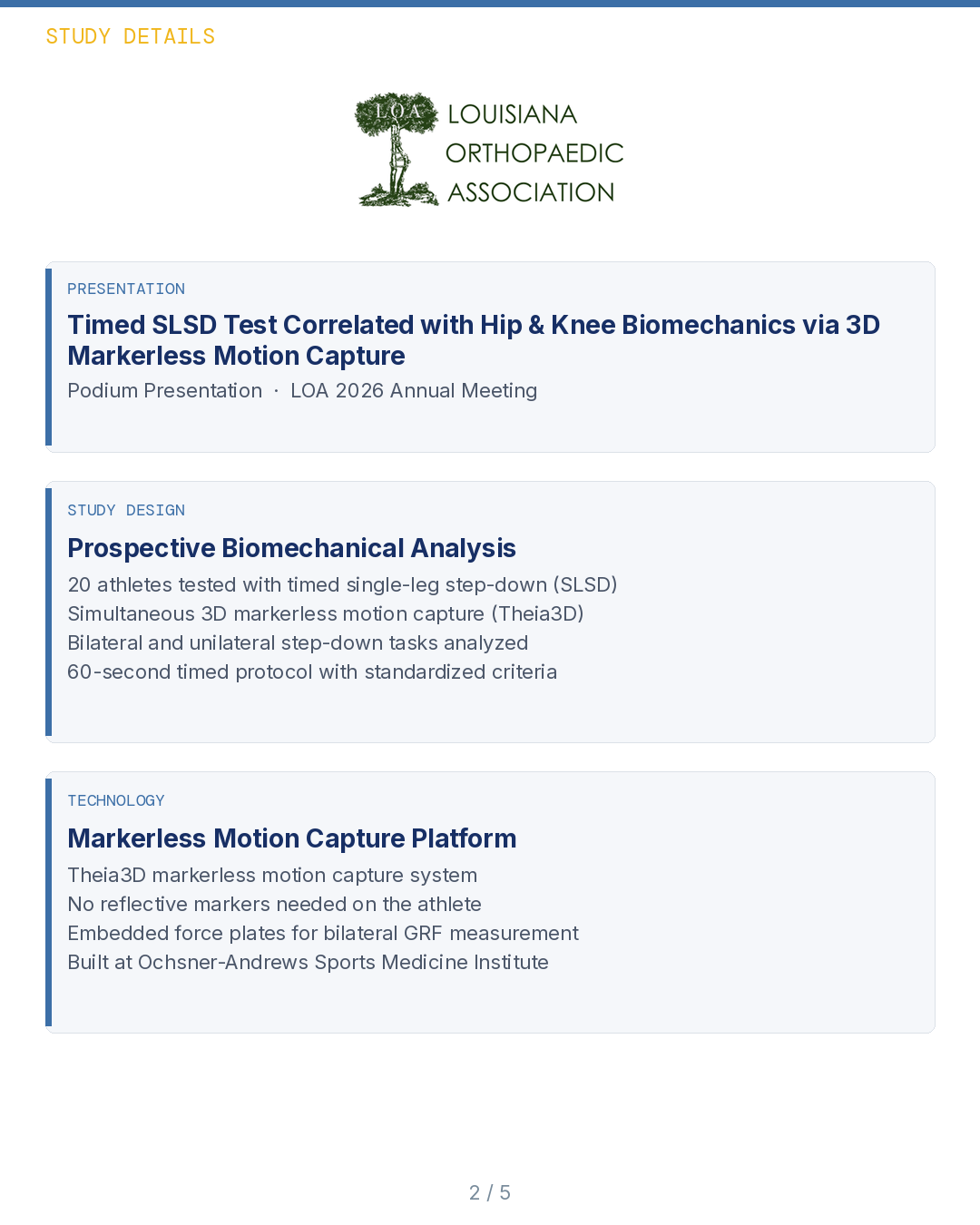
Anthony T. Drazick, MD, orthopaedic research fellow at Ochsner-Andrews Sports Medicine Institute, delivered a podium presentation at the 2026 Louisiana Orthopaedic Association Annual Meeting in New Orleans, Louisiana. The study demonstrated that performance on the timed single-leg step-down (SLSD) test is significantly correlated with hip and knee biomechanics measured by 3D markerless motion capture.
Twenty athletes were evaluated using a 60-second timed SLSD protocol with simultaneous 3D biomechanical analysis via the Theia3D markerless motion capture system. Both bilateral and unilateral step-down tasks were analyzed to assess frontal-plane and transverse-plane movement quality.
Key Findings
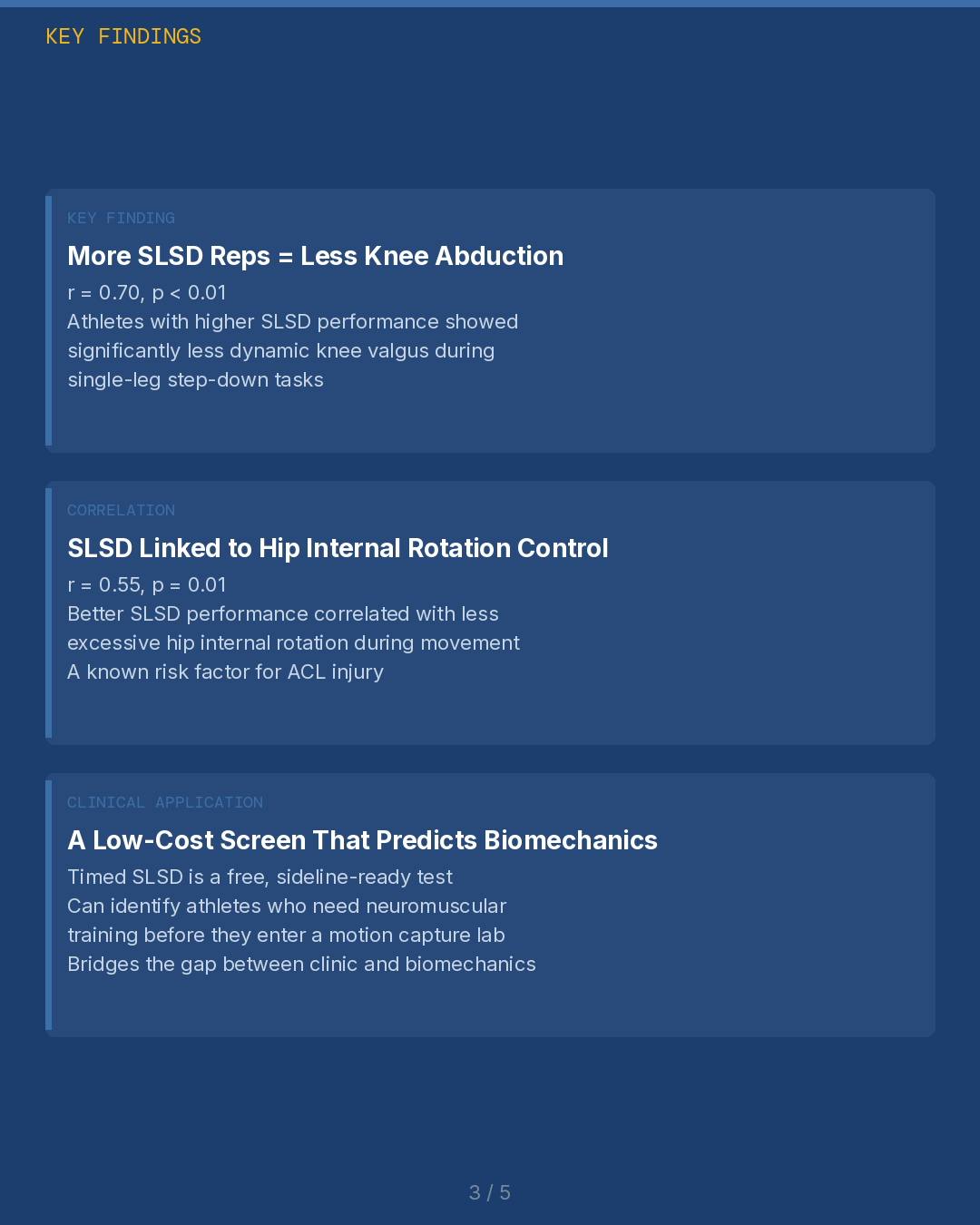
Athletes who performed more SLSD repetitions demonstrated significantly less dynamic knee abduction (r = 0.70, p < 0.01) and less excessive hip internal rotation (r = 0.55, p = 0.01) during single-leg step-down tasks. Both dynamic knee valgus and excessive hip internal rotation are well-established modifiable risk factors for ACL injury.
Clinical Significance
The SLSD test takes 60 seconds, costs nothing, and requires no equipment. This study validates it as a meaningful clinical screening tool that correlates with gold-standard 3D motion capture biomechanics. For athletic trainers and sports medicine clinicians, the SLSD offers a practical, sideline-ready method to identify athletes who may benefit from targeted neuromuscular training programs designed to reduce ACL injury risk.
This research bridges the gap between simple clinical screening and advanced biomechanical analysis, making movement quality assessment accessible outside the laboratory setting. For athletes who do require surgical intervention, Dr. Burnham specializes in ACL reconstruction using anatomic techniques supported by his published research.

Technology
This study utilized the Theia3D markerless motion capture platform at Ochsner-Andrews Sports Medicine Institute in Baton Rouge, Louisiana. The system uses video-based skeletal tracking without reflective markers, paired with embedded force plates for bilateral ground reaction force measurement.
Research Team
Authors: Anthony T. Drazick, MD; Ghislain Aminake, MD; Christopher Focht, MS; Chloe Roy, BS; Emily Clark, BS; Savannah Knighton, MAL, ATC, OTC; Edward Austin, PT, DPT; and Jeremy M. Burnham, MD. The presentation was delivered at the LOA 2026 Annual Meeting, March 20-21, 2026, at the InterContinental Hotel in New Orleans, Louisiana.
Related Research from Ochsner-Andrews Sports Medicine Institute
This presentation builds on a body of research from Dr. Burnham and colleagues examining the relationship between hip and core function, functional screening, and ACL injury risk. The following peer-reviewed publications provide additional context for this work:
- Burnham JM, Yonz MC, Robertson KE, et al. Relationship of hip and trunk muscle function with single leg step-down performance: implications for return to play screening and rehabilitation. Phys Ther Sport. 2016;22:66-73. doi:10.1016/j.ptsp.2016.05.007
- Kline PW, Burnham J, Yonz M, Johnson D, Ireland ML, Noehren B. Hip external rotation strength predicts hop performance after anterior cruciate ligament reconstruction. Knee Surg Sports Traumatol Arthrosc. 2018;26(4):1137-1144. doi:10.1007/s00167-017-4534-6
- Burnham JM, Drazick AT, Aminake G, Johnson DL, Ireland M, Noehren BW. Current concepts in hip and core assessment to reduce the risk of ACL injury. Int J Sports Phys Ther. 2026;21(2):210-222. doi:10.26603/001c.155471