
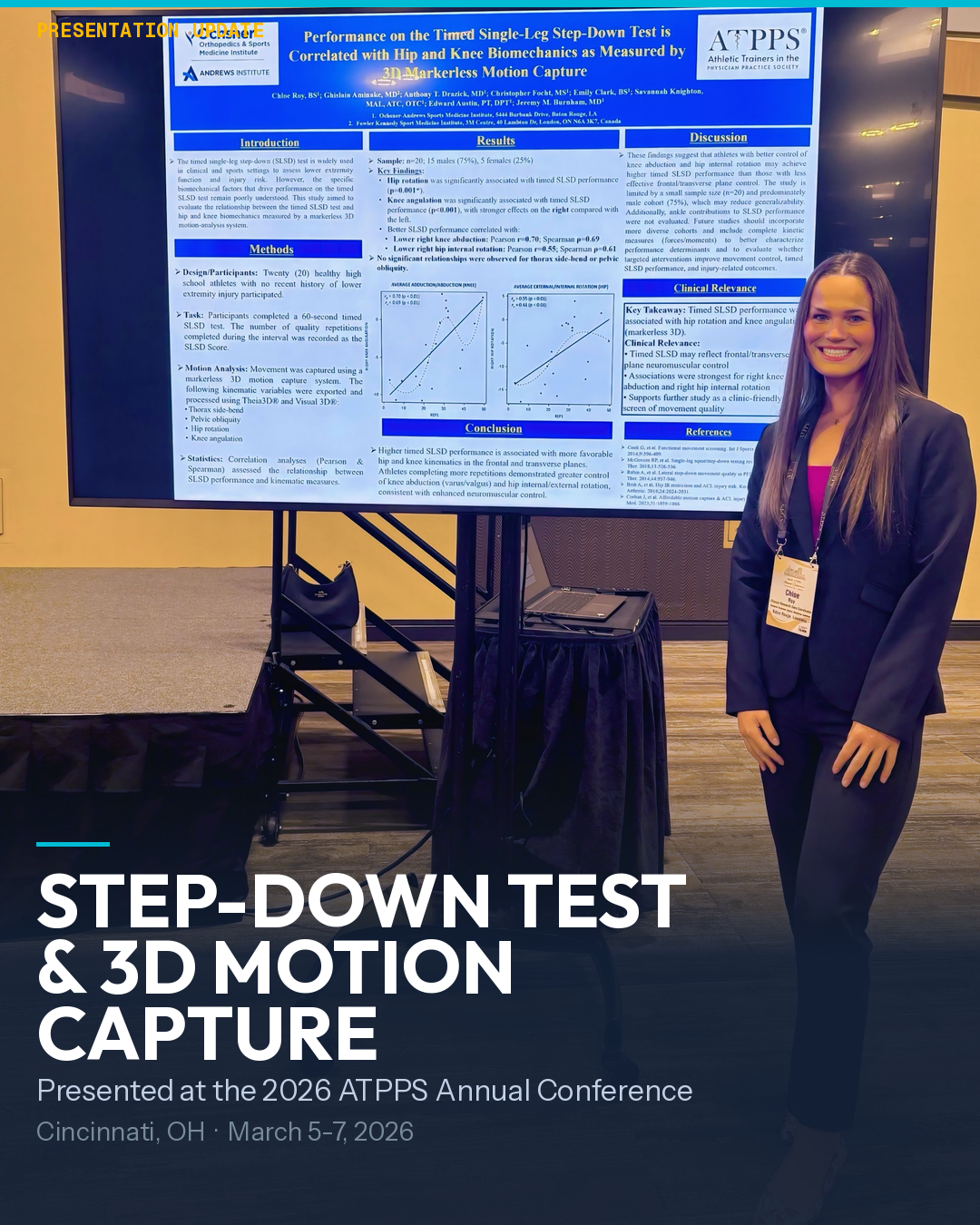
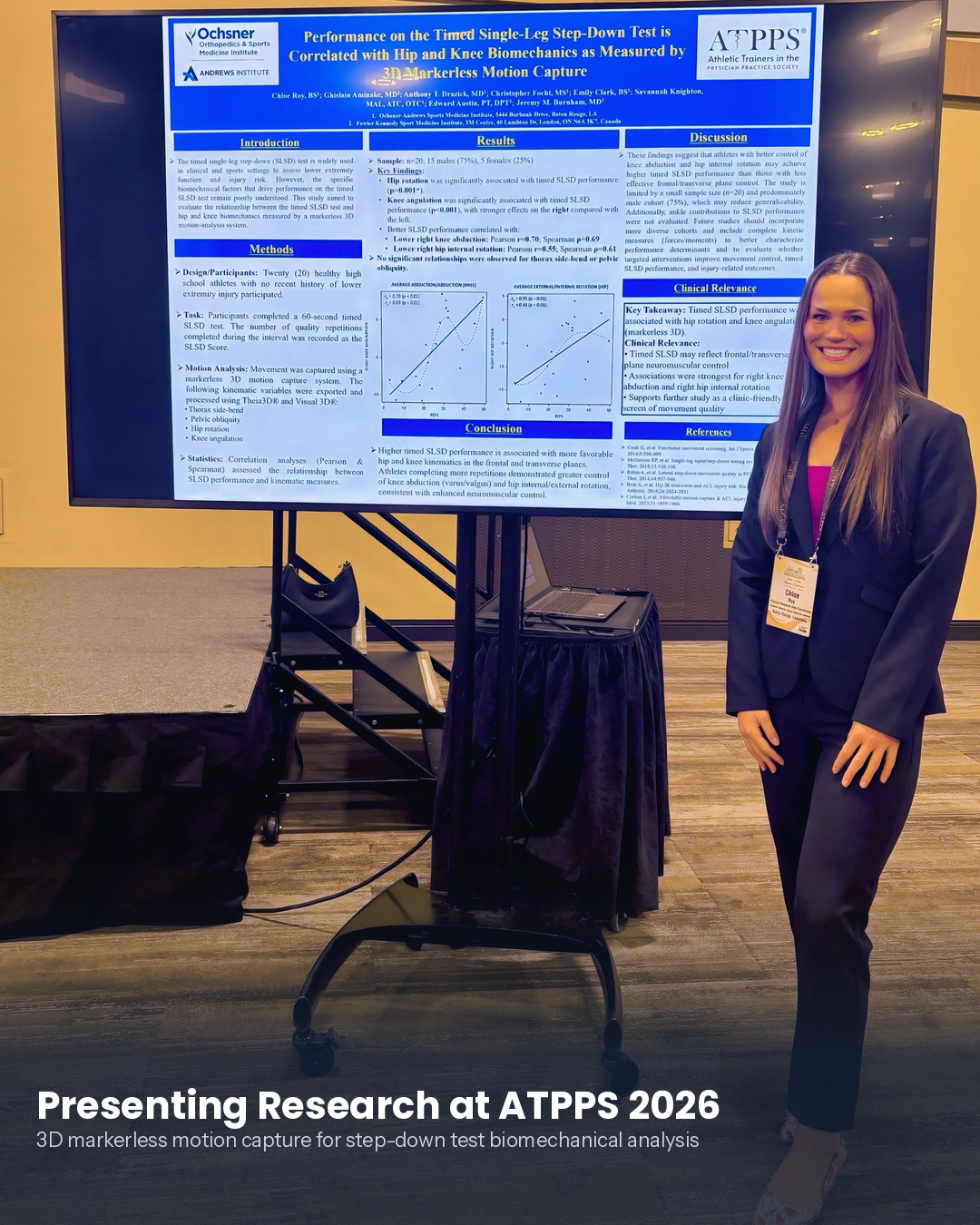
Chloe Roy, BS, our research data coordinator for Ortho, MSK, and Therapy & Wellness at Ochsner-Andrews Sports Medicine Institute’s Elite location in Baton Rouge, presented her poster at the 2026 ATPPS (Athletic Trainers in the Physician Practice Society) Annual Conference in Cincinnati, Ohio this past week.
Her poster, “Performance on the Timed Single-Leg Step-Down Test is Correlated with Hip and Knee Biomechanics as Measured by 3D Markerless Motion Capture,” addresses a question we think about every day in our clinic: can a simple, timed functional test tell us something meaningful about how an athlete actually moves?
Study Design and Methods
Using 3D markerless motion capture technology, our team analyzed 20 healthy high school athletes performing a 60-second timed single-leg step-down (SLSD) test. The goal was to determine whether performance on this commonly used clinical test correlates with objectively measured hip and knee biomechanics, specifically in the frontal and transverse planes where ACL injury risk factors tend to manifest.
Key Findings
The results showed that timed SLSD performance was significantly correlated with hip rotation in the frontal and transverse planes. Athletes who completed more repetitions demonstrated better control of knee abduction (valgus) and hip internal rotation. The associations were strongest for right knee abduction and right hip internal rotation, two movement patterns that have been consistently linked to ACL injury risk in the literature.

Clinical Implications
The clinical takeaway is clear: a 60-second timed step-down test, something any athletic trainer or physical therapist can perform in their clinic, may serve as a practical screening tool for identifying athletes with higher-risk movement patterns. This is part of our broader research program using markerless motion capture to make biomechanical assessment more accessible outside the traditional motion analysis lab. When we can identify risk factors with tools that clinicians already have, we can reach more athletes and potentially prevent more injuries.
Outstanding Research Team
This was a true collaborative effort, with Ghislain Aminake, MD, from Fowler Kennedy Sport Medicine Institute in London, Ontario playing a central role in driving this project forward alongside Chloe. This kind of cross-institutional collaboration strengthens the work and expands the impact of what we can accomplish in clinical research.
Chloe is a tremendous asset to our research program at Ochsner-Andrews Sports Medicine Institute and a great example of the impact young researchers can have when they are embedded in a clinical research environment and given the opportunity to contribute meaningfully. Poster presentations at national conferences like ATPPS represent the kind of scholarly work that raises the standard of care for the athletes and patients we serve.
Authors: Chloe Roy, BS; Ghislain Aminake, MD; Anthony T. Drazick, MD; Christopher Focht, MS; Emily Clark, BS; Savannah Knighton, MAL, ATC, OTC; Edward Austin, PT, DPT; Jeremy M. Burnham, MD
Conference: ATPPS 2026 Annual Conference, March 5-7, 2026, Cincinnati, OH
Jeremy Burnham, MD is a board-certified orthopedic surgeon and sports medicine specialist at Ochsner-Andrews Sports Medicine Institute in Baton Rouge, Louisiana. He specializes in ACL reconstruction, meniscus preservation, and complex knee injuries.