
Louisiana’s workers’ compensation system protects injured workers through a no-fault framework that pays for medical care and replaces lost wages after a job-related injury. Musculoskeletal injuries, including frequent knee and shoulder injuries, account for roughly one-third of permanent workplace disabilities nationwide (Daniels et al. 2017), and the Louisiana framework is shaped by one of the most worker-favorable rules in the Gulf South: under La. R.S. 23:1121, the injured worker chooses the treating physician. Understanding that right, along with reporting deadlines, medical and wage benefits, and the pathway through Maximum Medical Improvement (MMI) to settlement, helps injured Louisiana workers get the right orthopedic care and helps employers and workers’ compensation carriers meet their obligations, evaluate claims fairly, and make informed decisions at each stage of the process.
Jeremy M. Burnham, MD is a board-certified orthopedic surgeon specializing in musculoskeletal and orthopedic injuries, with particular focus on knee and shoulder conditions that drive the majority of workers’ compensation volume. He serves as System Vice Chair of Ochsner Health’s Musculoskeletal Service Line. His clinical treatment practice is based at Ochsner-Andrews Sports Medicine Institute in Baton Rouge, where injured workers may elect him as the treating orthopedic surgeon under La. R.S. 23:1121. In addition to his clinical practice, Dr. Burnham provides medicolegal services through Burnham Orthopedics & Sports Medicine to attorneys, adjusters, employers, and injured workers across Louisiana, Texas, Mississippi, Arkansas, Alabama, and Florida, serving as an independent evaluator (SMO, AMO, OWC-appointed IME), records reviewer, and orthopedic expert witness.
📋 In This Article
- How Louisiana Workers’ Compensation Works
- Your Right to Choose the Treating Orthopedic Surgeon
- Reporting the Injury: The 30-Day Employer Notice
- Filing Deadlines and the One-Year Rule
- Medical Benefits: What Louisiana Workers’ Comp Covers
- Indemnity Benefits: Wage Replacement (TTD, SEB, PPD, PTD)
- When Doctors Disagree: SMO, AMO, and the Tie-Breaker IME
- Maximum Medical Improvement and the AMA Guides Impairment Rating
- Return to Work: A Steady, Gradual Approach
- Disputed Claims: Form 1008 and the OWC Process
- How Louisiana Compares to Surrounding Gulf South States
- Why Injured Workers, Employers, Attorneys, and Carriers Choose Dr. Burnham
- References
- Frequently Asked Questions
How Louisiana Workers’ Compensation Works
Louisiana’s workers’ compensation system is codified at La. R.S. 23:1021 et seq. and administered by the Office of Workers’ Compensation Administration (OWC) within the Louisiana Workforce Commission. The system is built on a mutual compromise: injured workers give up the right to sue their employer for workplace injuries and, in return, they receive guaranteed medical coverage and wage replacement without having to prove the employer was at fault. Daniels and colleagues (2017) described this structure as the defining feature of every American workers’ compensation scheme, and it is the reason most Louisiana orthopedic injury claims are resolved administratively rather than in civil court.
Nearly every Louisiana employer is required to carry workers’ compensation insurance. Coverage applies when the injury arises out of and occurs in the course and scope of employment (La. R.S. 23:1031). That means the injury must be causally connected to the worker’s job duties or work environment. Workers’ compensation then pays the full cost of medically necessary treatment, with no copays, no deductibles, and no out-of-pocket medical expenses for the injured worker.
Musculoskeletal injuries make up the largest single category of workplace injury in every state, and they account for approximately one-third of all permanent workplace disabilities in the United States (Daniels et al. 2017). That is why orthopedic care sits at the center of most Louisiana workers’ comp claims. The most common orthopedic work injuries evaluated by Dr. Burnham include ACL and meniscus tears, rotator cuff tears, shoulder and knee dislocations, lumbar and cervical disc injuries, hand and wrist fractures, carpal tunnel syndrome, and tendon and ligament injuries of the elbow, wrist, ankle, and foot.
Your Right to Choose the Treating Orthopedic Surgeon (La. R.S. 23:1121)
Louisiana is one of the most worker-favorable states in the nation on the question of physician choice. Under La. R.S. 23:1121(B)(1), the injured employee has the right to select one treating physician in any field or specialty. After the initial choice, the worker must obtain consent from the employer or the insurer before switching to a different physician within the same field or specialty, but a change to a different specialty (for example, from a family physician to an orthopedic surgeon) does not require prior approval.
If the employer or insurer denies the injured worker’s right to an initial physician of choice, La. R.S. 23:1121 provides an expedited summary hearing before a workers’ compensation judge. The hearing must be set within three days of the motion and must be held between ten and thirty days after filing. This is one of the fastest due-process remedies in the Louisiana Workers’ Compensation Act, and it exists because the choice of the initial orthopedic surgeon is often the single most consequential decision in the life of the claim.
Choosing an experienced, evidence-based orthopedic surgeon as the treating physician protects the injured worker on several fronts. It ensures that the diagnosis is accurate, that conservative treatment is exhausted before surgery is proposed, that surgical authorization requests are supported by objective findings, and that the documentation in the medical record is written in plain, defensible language that will withstand scrutiny during utilization review, impairment rating, or an independent medical examination.
Reporting the Injury: The 30-Day Employer Notice
Louisiana law requires the injured worker to notify the employer of the workplace injury within 30 days of the date of injury, or within 30 days of the date the worker knew or should have known the injury was work-related (La. R.S. 23:1301 and 23:1031.1 for developing or occupational injuries). The notice should be in writing whenever possible, and the worker should retain a dated copy. When the injury results in death or in lost time greater than one week, the employer is then required, within 10 days of actual knowledge of the injury, to report it to its workers’ compensation insurer, which in turn forwards the report to the Office of Workers’ Compensation Administration (La. R.S. 23:1306).
Late reporting does not automatically defeat a claim, but it shifts the burden to the injured worker to prove that the delay did not prejudice the employer’s ability to investigate the accident and arrange timely medical care. Late reporting also creates leverage for the insurer to question whether the injury actually occurred at work. The safest practice is to notify a supervisor in writing as soon as the injury is recognized, describe the mechanism in objective terms, and request a formal incident report.
Filing Deadlines and the One-Year Rule
The second critical deadline is the prescription period for filing a disputed claim. Louisiana gives the injured worker one year from the date of the accident to file a formal claim for compensation, subject to several extensions. If the worker returns to work and later becomes disabled because of the same injury, the one-year clock starts from the first day of disability. If the worker has received temporary total disability (TTD) payments, the period runs one year from the last TTD payment. If the insurer has paid medical benefits, the claim period extends to three years from the last medical payment.
For “developing” or gradual-onset injuries (repetitive trauma, occupational disease, or injuries that progress without a single traumatic event), the filing period is one year from the date the injury causes disability, but no longer than three years from the original triggering event. Miscalculating these deadlines is one of the most common avoidable claim losses, and any injured worker approaching the one-year mark should consult a Louisiana workers’ compensation attorney.
Medical Benefits: What Louisiana Workers’ Comp Covers
Louisiana workers’ comp covers all reasonable and medically necessary treatment for the work-related injury. That includes emergency room and urgent care visits, office visits with the chosen treating physician and specialists, diagnostic imaging (X-ray, MRI, CT, ultrasound, EMG/nerve conduction studies), orthopedic surgery and all associated hospital and anesthesia costs, physical therapy and rehabilitation, injections (corticosteroid, viscosupplementation, platelet-rich plasma when authorized, biologic injections when authorized), prescription medications, durable medical equipment (braces, crutches, ambulatory assist devices), functional capacity evaluations, impairment rating examinations, and mileage reimbursement for travel to appointments.
The common thread through every covered service is medical necessity tied to the work injury. The treating physician’s documentation is the evidence base for that necessity. Dr. Burnham’s work on Louisiana workers’ comp cases, whether as the treating orthopedic surgeon at Ochsner-Andrews or as an independent evaluator through Burnham Orthopedics, centers on a disciplined, objective evaluation of whether each reported injury is causally related to a specific workplace accident, aggravation of a pre-existing condition, or an unrelated degenerative or non-occupational process. That causation judgment is built from a careful history of the mechanism, a focused physical examination, imaging correlation, and review of pre-injury medical records. Range-of-motion values in degrees, strength grades on validated scales, stability testing results, neurologic findings, imaging correlation, and serial comparisons are then the evidence that supports each authorization request and, later, the impairment rating.
Indemnity Benefits: Wage Replacement (TTD, SEB, PPD, PTD)
Louisiana’s wage-replacement benefits fall into four categories. Temporary Total Disability (TTD) benefits are paid when the injured worker is completely unable to work because of the injury, calculated at two-thirds (66 2/3%) of the pre-injury average weekly wage, subject to a statutory maximum that is 75% of the state average weekly wage in effect on the date of injury, and a statutory minimum of 20% of the state average weekly wage. The OWC updates these caps every year on September 1.
Supplemental Earnings Benefits (SEB) are paid when the injured worker has reached MMI or has been released to light-duty work but cannot return to pre-injury wages. SEB equals two-thirds of the difference between the pre-injury wages and the post-injury earning capacity. Permanent Partial Disability (PPD) benefits are paid for anatomical losses and losses of use under a scheduled body-part table (for example, a specific number of weeks of benefits for loss of a leg, arm, eye, or hand). Permanent Total Disability (PTD) benefits are paid in the rare cases where the worker can never return to any form of gainful employment, and those benefits can last for the worker’s lifetime.
Workers who do not return to work within twelve weeks of the injury have only about a 50% chance of ever returning to work (Daniels et al. 2017). That statistic is one of the strongest arguments for an aggressive, surgeon-driven rehabilitation protocol after MMI is reached.
When Doctors Disagree: SMO, AMO, and the Tie-Breaker IME (La. R.S. 23:1123)
Louisiana has a distinctive vocabulary for physician evaluations beyond the treating surgeon, and conflating them is one of the most common errors in WC litigation. A Second Medical Opinion (SMO) is a one-time evaluation by a physician selected by the employer or its insurer, authorized under La. R.S. 23:1121(B)(5). The SMO physician does not assume treatment; the purpose is an independent evaluation of diagnosis, causation, treatment appropriateness, MMI status, or impairment rating.
An Additional Medical Opinion (AMO) is the injured worker’s counterpart to an SMO, obtained when the worker seeks an independent second opinion at the insurer’s expense. An Independent Medical Examination (IME) in Louisiana specifically refers to the tie-breaker examination ordered under La. R.S. 23:1123 when the treating physician and the SMO physician disagree on condition or capacity to work. The IME physician is selected by the assistant secretary of the OWC (or the court), and the IME physician’s conclusions are “prima facie evidence of the facts therein stated” in any subsequent proceeding, which is why the Louisiana IME carries more weight than any other medical opinion in the claim.
Dr. Burnham’s clinical treatment practice operates through Ochsner-Andrews Sports Medicine Institute in Baton Rouge, where injured workers may elect him as the treating orthopedic surgeon under La. R.S. 23:1121. For medicolegal work, Dr. Burnham accepts referrals through Burnham Orthopedics & Sports Medicine as an SMO or AMO evaluator, as the OWC-appointed IME physician, as an orthopedic expert witness, and for medical records review. The treating-surgeon role is care-focused and carries a physician-patient treatment relationship. The SMO, AMO, IME, records-review, and expert-witness roles are strictly evaluative, with no treatment relationship with the injured worker.

Maximum Medical Improvement and the AMA Guides Impairment Rating
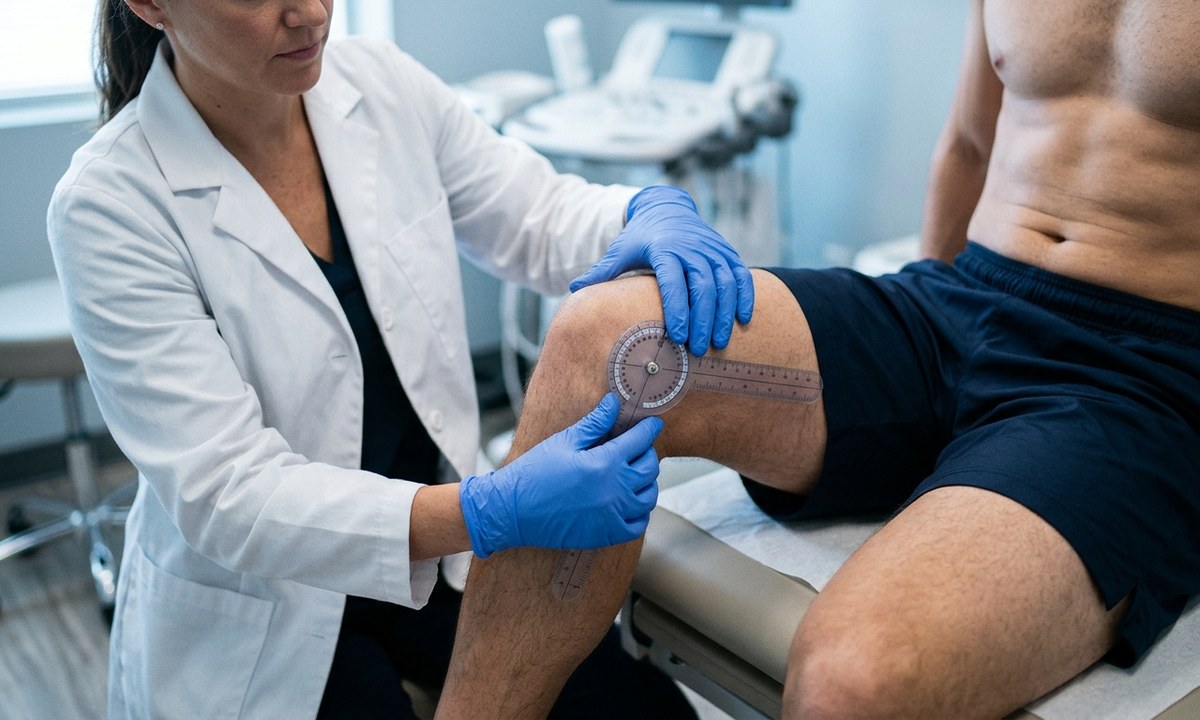
Maximum Medical Improvement (MMI) is the point at which the worker’s condition has stabilized and no further significant improvement is expected from continued medical treatment. MMI is a medical determination made by the treating physician on the basis of serial objective data (range-of-motion plateau, strength plateau, imaging stability, functional test scores). For a knee injury, that might mean flexion and extension measurements in degrees at each visit, isokinetic quadriceps and hamstring strength indices, and post-operative MRI findings. For a shoulder injury, it might mean forward flexion, abduction, internal and external rotation measurements, rotator cuff strength grading, and imaging of the repair or reconstruction. MMI triggers the shift from temporary disability benefits to permanent disability evaluation, and it is one of the most consequential medical judgments in the claim.
After MMI, the treating physician or an SMO/IME evaluator assigns a permanent impairment rating. Louisiana calculates impairment ratings using the AMA Guides to the Evaluation of Permanent Impairment, Sixth Edition, with automatic adoption of subsequent digital updates. Impairment is a medical concept: it quantifies the loss of anatomic or functional integrity as a whole-person percentage. Disability is a separate, vocational concept: two workers with the same 10% whole-person impairment may have very different disabilities depending on their occupation and transferable skills (Daniels et al. 2017). Louisiana attorneys and insurers often blur that distinction, and a precise Sixth-Edition impairment rating, with page and table citations, is one of the most valuable products of a well-documented orthopedic evaluation. Dr. Burnham is trained and experienced in applying the AMA Guides impairment methodology, the distinction between impairment and disability, and the work restrictions and limitations framework used by adjusters, attorneys, and workers’ compensation judges throughout the Gulf South.
Return to Work: A Steady, Gradual Approach
The goal of workers’ compensation orthopedic care is a safe, steady, and gradual return to productive work, not an indefinite period off-duty. Workers who remain out of work beyond twelve weeks have only about a 50% chance of ever returning to work (Daniels et al. 2017), and prolonged inactivity is itself associated with deconditioning, mood decline, and worse long-term musculoskeletal outcomes. The best outcomes, for the injured worker and for the employer, come from returning the worker to meaningful duty as soon as it is medically safe, even when full duty is still weeks or months away. Most injured workers should not be held off work for the entire span of their recovery.
At every stage of the recovery arc, the treating orthopedic surgeon issues a work status in one of three categories: full duty, modified or light duty, or off work. Off-work status is appropriate for the acute injury window and the immediate post-operative phase, when any meaningful work activity would jeopardize healing. Modified or light duty is the expected default through most of the recovery timeline, with restrictions progressively loosened as strength, range of motion, and objective function improve. Full duty is reached when the worker can safely perform the physical demands of the job without meaningful risk to the healing injury or to co-workers.
When modified duty is ordered, the surgeon distinguishes between restrictions (risk-based guidance on what the worker should or should not do) and limitations (capacity-based findings of what the worker can or cannot do) as defined in the AAOS framework for workers’ comp (Daniels et al. 2017). Restrictions are forward-looking and protective; limitations are observational and objective. Blurring the two is a frequent source of insurer disputes. Return-to-work orders are most useful when they are specific, functional, and time-limited rather than generic. Functional Capacity Evaluations (FCEs) are used when the work status is complex or contested, and FCE data are integrated with the rehabilitation record to anchor recommendations in objective performance.
Disputed Claims: Form 1008 and the OWC Process
When benefits are denied or disputed (treatment authorization, choice of physician, indemnity rate, MMI, impairment rating, return-to-work status, or settlement value), either party can file a disputed claim using OWC Form 1008 (Disputed Claim for Compensation). The form is filed with the OWC district office, and the case is assigned to a workers’ compensation judge. The OWC main office phone is (225) 342-7970 in Baton Rouge, with a statewide toll-free line at (800) 201-2499.
Disputed claims typically proceed through mediation before or after the 1008 filing, followed by a formal hearing before the workers’ compensation judge, usually within 60 to 90 days of filing. The judge’s decision can be appealed to the Louisiana Court of Appeals within 30 days. During the dispute, the medical evidence carries decisive weight. Objective, contemporaneous, and well-documented orthopedic records built on the treating surgeon’s consistent measurements are the single best tool an injured worker has to win a 1008 proceeding.
How Louisiana Compares to Surrounding Gulf South States
Dr. Burnham receives medicolegal and second-opinion referrals from attorneys, adjusters, and injured workers across the Gulf South. Each state’s workers’ compensation statute frames the same questions (choice of physician, IME authority, presumptive weight, dispute resolution) in its own vocabulary. The table below summarizes the core structural differences for orthopedic matters.
| State | Key Statute | Who Chooses the Treating Physician | Independent / Tie-Breaker Examination |
|---|---|---|---|
| Louisiana | La. R.S. 23:1121, 23:1123 | Employee selects one treating physician per specialty | OWC-appointed IME under R.S. 23:1123 when treating and SMO disagree; prima facie evidentiary weight |
| Texas | Tex. Labor Code § 408.004, § 408.0041 | Employee selects from DWC-approved list (or the network list in network claims) | Required Medical Exam (RME) by carrier-selected, DWC-approved physician; DWC-appointed Designated Doctor (DD) with presumptive weight |
| Mississippi | Miss. Code § 71-3-15 | Employee may accept employer referral or select own competent physician | Employer Medical Exam (EME) for disability evaluation; MWCC-appointed IME when estimates are disputed |
| Arkansas | Ark. Code § 11-9-511, § 11-9-514 | Employer selects initial treating physician; change of physician requires Commission order under § 11-9-514 | Commission-ordered physical examination under § 11-9-511; benefits suspended if worker refuses |
| Alabama | Ala. Code § 25-5-77 | Employer selects first treating physician; if the worker is dissatisfied, the worker selects from a panel of four alternative physicians (one panel only) | Employer-requested medical examination with the worker’s right to have an additional physician present |
| Florida | Fla. Stat. § 440.13 | Carrier selects authorized treating physician; worker has a one-time change of physician | IME by either party; Expert Medical Advisor (EMA) when treating physicians disagree, with a presumption of correctness absent clear and convincing evidence to the contrary |
Louisiana and Mississippi sit on the worker-favorable end of the spectrum on the question of who picks the treating physician. Arkansas, Alabama, and Florida place that choice in the hands of the employer or the carrier in the first instance. Texas occupies a hybrid position, with a structured DWC panel of approved physicians. Across all six states, the evaluator with presumptive weight in a contested case (the LA IME, the TX Designated Doctor, the FL EMA, the MS MWCC IME) is appointed by the state rather than chosen by either party, which is why the quality and defensibility of the medical record matters more than any other variable in the claim.
Why Injured Workers, Employers, Attorneys, and Carriers Choose Dr. Burnham
Dr. Burnham is board-certified in orthopedic surgery and in orthopedic sports medicine (dual ABOS certification), Regional Department Head of Orthopedic Surgery, System Vice Chair of Ochsner Health’s Musculoskeletal Service Line, and Medical Director of the Therapy and Wellness Service Line. He completed orthopedic surgery residency at the University of Kentucky under Darren Johnson, MD, Mary Lloyd Ireland, MD, and Christian Lattermann, MD, and sports medicine fellowship at the University of Pittsburgh Medical Center under Freddie H. Fu, MD, James Bradley, MD, and Volker Musahl, MD. He has authored more than 145 peer-reviewed publications, book chapters, and scientific presentations, and is the most published ACL surgeon in Louisiana.
Dr. Burnham serves as Site Principal Investigator on the STABILITY 2 Trial (NIH-funded, ClinicalTrials.gov NCT03935750) and the STaR Trial (Department of Defense-funded, ClinicalTrials.gov NCT03543098), and is the recipient of the Arthritis Foundation Game Changer Award and the American Orthopaedic Society for Sports Medicine (AOSSM) Playmaker Award. He has been named a Castle Connolly Top Doctor (peer-nominated national recognition) and is a member of the AOSSM BOLD Leadership Cohort. Former team physician roles include professional sports teams, the University of Pittsburgh, and Southern University, and he practiced team medicine for collegiate athletes across multiple disciplines. That combination of active surgical practice, national research leadership, and team-medicine experience translates into WC records that attorneys, adjusters, judges, and IME evaluators find credible and complete.
References
- Daniels AH, Kuris EO, Palumbo MA. The Role of the Orthopaedic Surgeon in Workers’ Compensation Cases. J Am Acad Orthop Surg. 2017;25(3):e45-e52. PMID: 28199293. DOI: 10.5435/JAAOS-D-16-00499.
- Louisiana Workers’ Compensation Act, La. R.S. 23:1021 et seq. Louisiana Revised Statutes, Title 23.
- La. R.S. 23:1121 (Examination of injured employee; choice of physician). Statute text.
- La. R.S. 23:1123 (Disputes as to condition or capacity to work; additional medical opinion under supervision of the secretary). Statute text.
- Texas Labor Code § 408.004 and § 408.0041 (Required Medical Examination; Designated Doctor Examination). Statute text.
- Mississippi Code § 71-3-15 (Medical services and supplies). Statute text.
- Arkansas Code § 11-9-511 (Medical services and supplies, physical examination) and § 11-9-514 (Change of physician). Statute text.
- Alabama Code § 25-5-77 (Expenses of medical and surgical treatment; medical examinations). Statute text.
- Florida Statute § 440.13 (Medical services and supplies; IME; Expert Medical Advisor). Statute text.
- American Medical Association. Guides to the Evaluation of Permanent Impairment, Sixth Edition (AMA, 2008; digital updates through 2021-2022). amaguides.com. Edition used by Louisiana for workers’ compensation impairment ratings.
Frequently Asked Questions
Who picks the doctor in a Louisiana workers’ comp claim?
Under La. R.S. 23:1121(B)(1), the injured worker has the right to select one treating physician in any field or specialty.
How long do I have to report a Louisiana work injury and file a claim?
30 days to notify the employer (La. R.S. 23:1301). Form 1008 must be filed within one year of accident.
What is the difference between an SMO, an AMO, and an IME in Louisiana?
SMO = employer/insurer-selected physician. AMO = worker’s counterpart at insurer’s expense. IME under La. R.S. 23:1123 = tie-breaker exam with prima facie evidentiary weight.
How much does Louisiana workers’ comp pay?
TTD at 66 2/3% of AWW, cap 75% of state AWW, floor 20%. SEB at two-thirds of wage differential. PPD on scheduled body-part table. PTD for lifetime when no gainful employment possible.
What is MMI in Louisiana?
MMI is when condition has stabilized and no further improvement is expected. Louisiana uses AMA Guides Sixth Edition for post-MMI impairment rating.
Does Louisiana workers’ comp cover injured workers from surrounding states?
Jurisdiction is governed by state of injury and state of the employer’s policy. Dr. Burnham treats and evaluates workers from LA, TX, MS, AR, AL, and FL in terms compatible with each state’s statute.
Jeremy M. Burnham, MD is a board-certified orthopedic surgeon specializing in musculoskeletal and orthopedic injuries, with particular focus on knee and shoulder conditions. He holds dual ABOS board certification in Orthopedic Surgery and in Orthopedic Sports Medicine, and serves as System Vice Chair of Ochsner Health’s Musculoskeletal Service Line, Regional Department Head of Orthopedic Surgery, and Medical Director of the Therapy and Wellness Service Line. His clinical treatment practice is based at Ochsner-Andrews Sports Medicine Institute in Baton Rouge, where injured workers may elect him as their treating orthopedic surgeon under La. R.S. 23:1121. In addition to his clinical practice, Dr. Burnham provides medicolegal services through Burnham Orthopedics & Sports Medicine to attorneys, adjusters, employers, and injured workers across Louisiana, Texas, Mississippi, Arkansas, Alabama, and Florida as an SMO/AMO evaluator, OWC-appointed IME physician, records reviewer, and orthopedic expert witness. Dr. Burnham is trained and experienced in applying the AMA Guides to the Evaluation of Permanent Impairment and the distinction between impairment and disability. Dr. Burnham completed orthopedic residency at the University of Kentucky (Drs. Darren Johnson, Mary Lloyd Ireland, and Christian Lattermann) and sports medicine fellowship at the University of Pittsburgh Medical Center (Drs. Freddie Fu, James Bradley, and Volker Musahl). He has authored more than 145 peer-reviewed publications, book chapters, and scientific presentations, serves as Site Principal Investigator on the STABILITY 2 and STaR trials, and has received the Arthritis Foundation Game Changer Award and the AOSSM Playmaker Award.