
If you’re over 40, your muscles are disappearing. That’s not a scare tactic, it’s physiology. After age 30, you lose 3 to 8 percent of your muscle mass per decade, and the rate accelerates after 60 (Volpi et al., Curr Opin Clin Nutr Metab Care, 2004). The medical term is sarcopenia, and as an orthopedic surgeon who operates on people from their teens to their eighties, I can tell you it’s one of the most important (and most preventable) threats to long-term function and independence.
The good news is that the single most effective intervention to slow or reverse age-related muscle loss is something you can start today: resistance training. A recent systematic review and meta-analysis found that muscle-strengthening activities were associated with up to a 46% lower risk of all-cause mortality (Momma et al., Br J Sports Med, 2022). That’s not a marginal benefit. That’s a nearly halved risk of dying from any cause. Here’s what the evidence says, what I see in my operating room, and exactly how much you need to do.
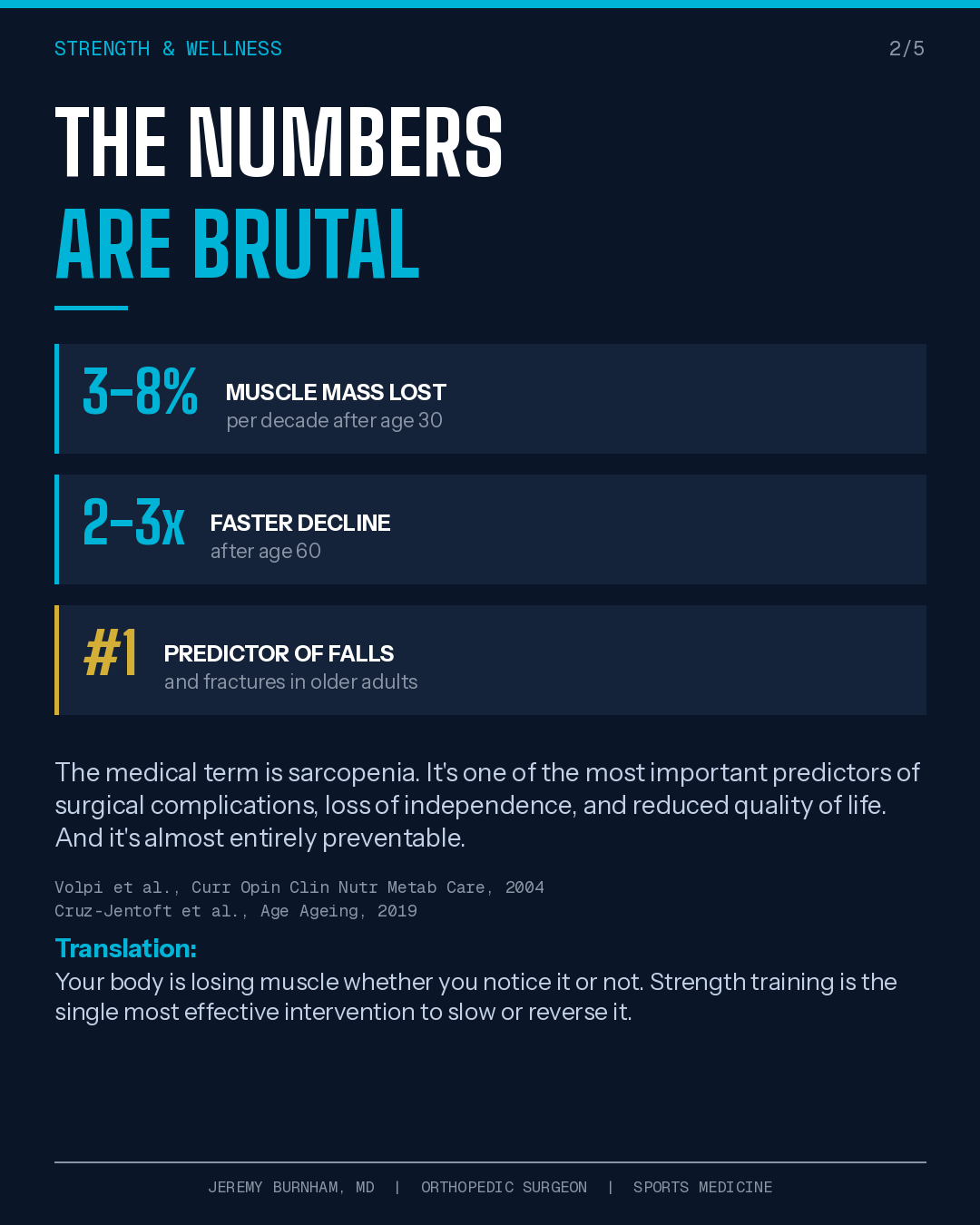
The Numbers Are Brutal
Sarcopenia (the progressive loss of skeletal muscle mass and strength) is one of the most important predictors of falls, fractures, surgical complications, and loss of independence in older adults. The European Working Group on Sarcopenia in Older People (EWGSOP2) revised consensus recognizes it as a muscle disease with serious health consequences when untreated (Cruz-Jentoft et al., Age Ageing, 2019).
The trajectory is predictable: 3 to 8 percent loss per decade starting at 30, accelerating two to three times faster after 60. By age 70, adults who haven’t engaged in resistance training may have lost 30% or more of their peak muscle strength. This isn’t just about aesthetics or gym performance. It directly impacts your ability to get out of a chair, recover from surgery, and maintain your independence as you age. And for my patients considering knee replacement or other major joint surgery, it’s one of the most important variables I evaluate.
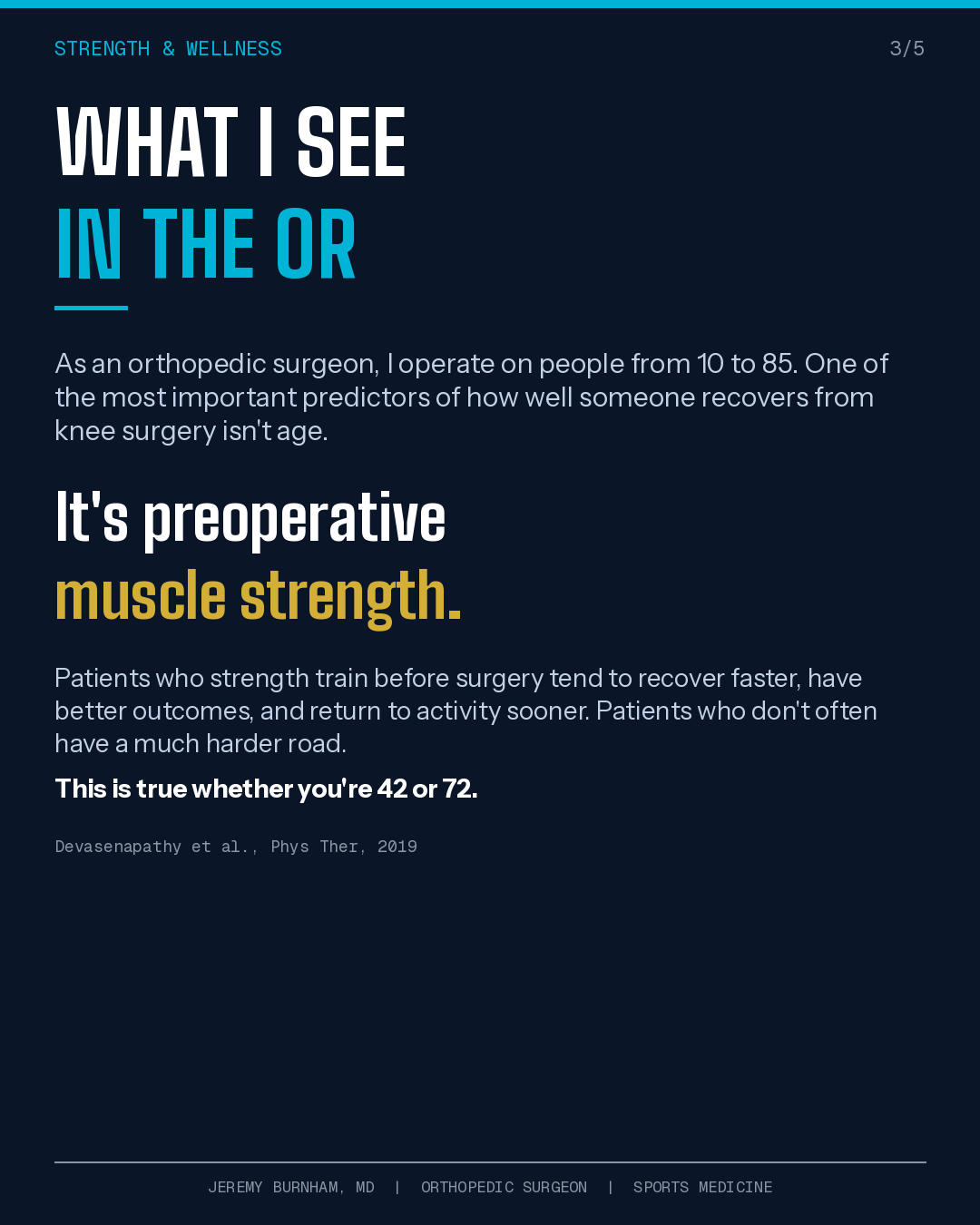
What I See in the OR
As an orthopedic surgeon, I operate on people from 10 to 85. One of the most important predictors of how well someone recovers from knee surgery isn’t age. It’s preoperative muscle strength. A systematic review found that preoperative quadriceps strength and functional ability are among the strongest predictors of performance-based outcomes 6 months after total knee arthroplasty (Devasenapathy et al., Phys Ther, 2019).
I see this play out every week. Patients who strength train before surgery tend to recover faster, have better functional outcomes, and return to activity sooner. Patients who don’t often have a much harder road: more pain, more stiffness, more physical therapy sessions before they reach the same milestones. This is true whether you’re 42 or 72. If you’re considering ACL reconstruction or any lower extremity procedure, the strength you build before surgery is one of the best investments you can make in your recovery.
The Minimum Effective Dose
The ACSM (American College of Sports Medicine) Position Stand recommends resistance training on two to three days per week for each major muscle group (Garber et al., Med Sci Sports Exerc, 2011). That’s the minimum effective dose, and it’s remarkably accessible. You don’t need a fancy gym or a personal trainer. You need compound movements (squats, deadlifts, presses, rows), progressive overload (gradually increasing weight or difficulty), and consistency. Thirty to forty-five minutes, twice a week, is the floor.
I also recommend mixing in eccentric and isometric exercises, particularly for tendon health. Research shows that isometric contractions can reduce tendon pain and increase strength in conditions like patellar tendinopathy (Rio et al., Br J Sports Med, 2015), while eccentric exercises are effective for long-term tendinopathy management (Lim & Wong, Physiother Res Int, 2018). This variety isn’t just about muscle. It’s about building the tendons, ligaments, and connective tissue that protect your joints over the long term.
Bodyweight exercises are a great place to start. Push-ups, lunges, step-ups, and planks are legitimate strength training movements that require zero equipment. Add weight gradually as you progress. The key is starting and being consistent.

Start Now. Not Later.
Resistance training doesn’t just build muscle. It also increases bone mineral density and strengthens the tendons, ligaments, and cartilage that protect your joints. The myth that lifting is “bad for your joints” is exactly backwards. Controlled, progressive loading is one of the best things you can do for joint health, and the evidence supports this across age groups.
The mortality data is equally compelling. A systematic review and meta-analysis of cohort studies found that muscle-strengthening activities were associated with a 10 to 17 percent lower risk of all-cause mortality, cardiovascular disease, total cancer, diabetes, and lung cancer, with the maximum risk reduction observed at approximately 30 to 60 minutes per week (Momma et al., Br J Sports Med, 2022). When combined with aerobic activity, the risk reduction for all-cause mortality reached up to 46%.
If you’re over 40 and not strength training at least twice a week, you’re leaving health, function, and resilience on the table. As a surgeon, I’d rather see you in the gym than in my office. Start with bodyweight if you need to. Add weight gradually. Be consistent. Your future self will thank you.
The Bottom Line
After age 30, your body is losing muscle whether you notice it or not. Sarcopenia drives falls, fractures, poor surgical outcomes, and loss of independence, and it’s almost entirely preventable. Two resistance training sessions per week is enough to maintain and build muscle at any age. The data on mortality reduction is striking, the evidence on surgical recovery is clear, and the minimum effective dose is accessible to nearly everyone. Compound movements, progressive overload, consistency. Move something heavy. Do it twice a week. Your joints will thank you.
If you’re dealing with joint pain, a prior injury, or want guidance on training safely around an existing condition, contact our office to schedule a consultation. Whether you’re preparing for surgery or trying to avoid it, a personalized plan can make all the difference. Learn more about Dr. Burnham and his approach to sports medicine and keeping active patients moving.
References
- Volpi E, Nazemi R, Fujita S. Muscle tissue changes with aging. Curr Opin Clin Nutr Metab Care. 2004;7(4):405-410. PMID: 15192443.
- Cruz-Jentoft AJ, Bahat G, Bauer J, et al. Sarcopenia: revised European consensus on definition and diagnosis. Age Ageing. 2019;48(1):16-31. PMID: 30312372.
- Garber CE, Blissmer B, Deschenes MR, et al. ACSM Position Stand: Quantity and quality of exercise. Med Sci Sports Exerc. 2011;43(7):1334-1359. PMID: 21694556.
- Devasenapathy N, Maddison R, et al. Preoperative quadriceps muscle strength and functional ability predict performance-based outcomes 6 months after total knee arthroplasty. Phys Ther. 2019;99(1):46-61. PMID: 30329137.
- Rio E, Kidgell D, Purdam C, et al. Isometric exercise induces analgesia and reduces inhibition in patellar tendinopathy. Br J Sports Med. 2015;49(19):1277-1283. PMID: 25979840.
- Lim HY, Wong SH. Effects of isometric, eccentric, or heavy slow resistance exercises on pain and function in individuals with patellar tendinopathy: A systematic review. Physiother Res Int. 2018;23(4):e1721. PMID: 29972281.
- Momma H, Kawakami R, Honda T, et al. Muscle-strengthening activities are associated with lower risk and mortality in major non-communicable diseases: a systematic review and meta-analysis. Br J Sports Med. 2022;56:755-763. PMID: 35228201.
Dr. Burnham is a board-certified orthopedic surgeon and sports medicine specialist at Ochsner Sports Medicine Institute in Baton Rouge, Louisiana. Recognized for his expertise in complex knee reconstruction, ACL surgery, and advanced shoulder procedures, Dr. Burnham combines cutting-edge research with personalized patient care. As a published researcher and active member of the American Academy of Orthopaedic Surgeons, he specializes in helping athletes and active individuals return to peak performance through both surgical and non-surgical treatments. For appointments or consultations, click CONTACT US.
Frequently Asked Questions About Strength Training After 40
Research shows that adults lose 3 to 8 percent of their skeletal muscle mass per decade starting around age 30, with the rate accelerating two to three times after age 60 (Volpi et al., 2004). Without resistance training, adults may lose 30% or more of their peak muscle strength by age 70. This process, called sarcopenia, is one of the most important predictors of falls, fractures, and loss of independence in older adults.
The American College of Sports Medicine (ACSM) recommends resistance training on two to three days per week for each major muscle group (Garber et al., Med Sci Sports Exerc, 2011). Two sessions per week of 30 to 45 minutes each, focusing on compound movements with progressive overload, is sufficient to maintain and build muscle mass at any age.
No, this is a common myth. Controlled, progressive resistance training actually strengthens the tendons, ligaments, and cartilage that protect your joints, and increases bone mineral density. Isometric and eccentric exercises have been shown to reduce tendon pain and improve function in conditions like patellar tendinopathy (Rio et al., Br J Sports Med, 2015; Lim & Wong, Physiother Res Int, 2018). As an orthopedic surgeon, I recommend resistance training to nearly every patient I see.
Yes. A systematic review found that preoperative quadriceps strength and functional ability are among the strongest predictors of performance-based outcomes 6 months after total knee arthroplasty (Devasenapathy et al., Phys Ther, 2019). Patients who strength train before knee surgery tend to recover faster, have better functional outcomes, and return to activity sooner than patients who go into surgery deconditioned.
Yes. A systematic review and meta-analysis of cohort studies found that muscle-strengthening activities were associated with a 10 to 17 percent lower risk of all-cause mortality, cardiovascular disease, total cancer, diabetes, and lung cancer. When combined with aerobic activity, the risk reduction for all-cause mortality reached up to 46% (Momma et al., Br J Sports Med, 2022). The maximum benefit was observed at approximately 30 to 60 minutes of strength training per week.
Further Reading: Supplements, Recovery & Diet
Strength training after 40 works best when paired with attention to recovery, supplementation, and diet quality. Companion articles on this site cover why creatine isn’t just for bodybuilders, the evidence behind collagen supplementation beyond skin health, GLP-1 drugs and their effect on bone density and muscle mass, how conventional meat production may drive rheumatoid arthritis risk, and a medical perspective on antibiotic use in poultry. For patients looking at equipment adaptations, see adaptive golf gloves for maintaining grip.