
The American College of Sports Medicine just released the first major update to their resistance training guidelines in 17 years, and the shift is significant. After nearly two decades of recommending 70% of one-rep max as the intensity floor, ACSM’s 2025 guidelines introduce a framework that’s more practical, more accessible, and honestly more aligned with how evidence-based athletes and clinicians actually program strength.
For my patients recovering from ACL surgery, knee replacements, and other musculoskeletal injuries, this update validates an approach many of us in sports medicine have been using for years. It’s a reminder that the science evolves, and so should our programming. Let me walk you through what changed and why it matters.
In This Article
The 17-Year Gap
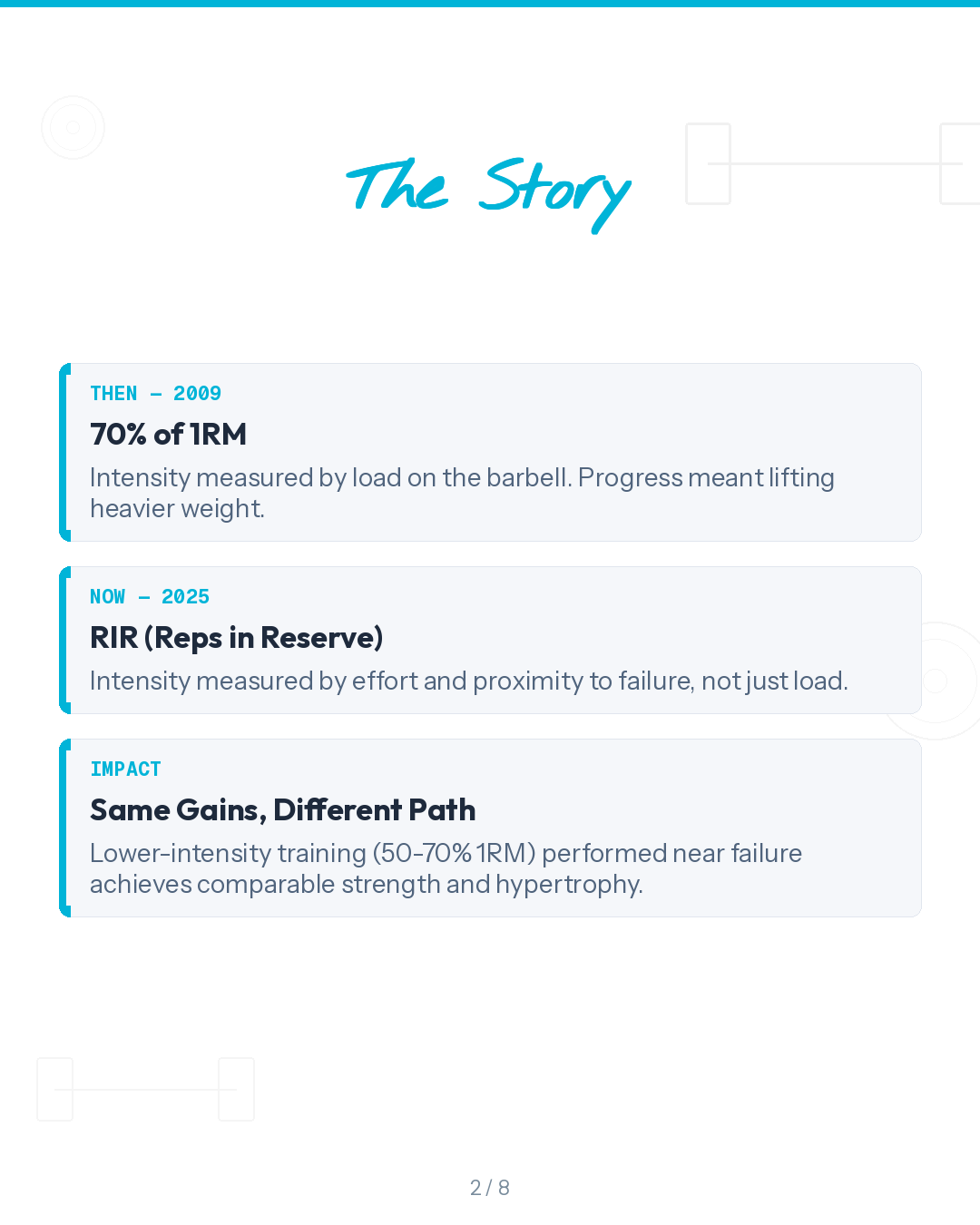
The 2009 ACSM position stand was clear and prescriptive. For hypertrophy, aim for 70 to 100% of your one-repetition maximum. For strength, even higher. The framework was load-centric: progress meant lifting heavier weight. This wasn’t wrong, it was just incomplete.
But a lot has changed in 17 years. We’ve seen advances in exercise science, more nuanced understanding of neuromuscular adaptation, and real-world evidence from thousands of athletes training across different modalities and injury states. We’ve also seen the limitations of percentage-based programming: not everyone has access to accurate 1RM testing, individual variation is larger than a simple percentage can capture, and many populations (post-surgical patients, older adults, injured athletes) respond just as well to lighter loads when the effort is high.
The new guidelines reflect that reality.
What Changed: From Percentages to RIR
The headline shift: ACSM now recommends using Reps in Reserve (RIR) as the primary method to quantify training intensity and effort. Instead of asking “What percentage of my 1RM am I lifting?” athletes and clinicians now ask “How many reps could I still do before failure?”
RIR is straightforward. If you complete a set of 10 repetitions but feel you could do 3 more before hitting failure, you have 3 reps in reserve. That’s 3 RIR. If you can only do 1 more, that’s 1 RIR. Zero RIR means you’ve reached volitional failure on that set.
Why does this matter? Because RIR captures both the load AND the effort, making it far more adaptive to individual variation. Two lifters at 70% of their 1RM might have completely different numbers of reps remaining because their leverage, training age, and daily fatigue state differ. The old framework would say both are at the same intensity. The new one says they’re not, and adjusts accordingly.

The Evidence Behind the Shift
The 2009 guidelines emphasized that achieving 70% of 1RM or higher was necessary for meaningful hypertrophy and strength gains. That recommendation was based on solid science at the time, but it created an implicit barrier: if you couldn’t test or estimate your 1RM accurately, or if your injury status prevented you from lifting heavy, you were outside the “optimal” zone.
The 2025 update reflects two major insights from recent research:
First, proximity to failure matters more than absolute load. Multiple randomized controlled trials over the past decade have shown that training to within 0 to 3 reps of failure produces similar strength and hypertrophy gains across a surprisingly wide range of loads, from 30% to 90% of 1RM. What drives adaptation isn’t the barbell weight itself, it’s the neuromuscular effort and metabolic demand created by approaching failure.
Second, individualization beats prescription. A patient recovering from ACL surgery who can comfortably lift 50% of their pre-injury 1RM with 2 RIR is achieving the same neuromuscular stimulus as a healthy athlete lifting 80% of 1RM with 2 RIR. The joint stress is lower, but the training effect is comparable. That’s a game-changer for post-surgical rehab and injury prevention.
Who Benefits Most
Post-Surgical Patients. This is where I see the most immediate clinical benefit. A patient eight weeks out from ACL reconstruction isn’t ready to test or estimate a 1RM. But they can certainly perform resistance exercises to 2 or 3 RIR with a lighter load, building strength without excessive joint stress. The new framework gives us a clear intensity target without forcing premature heavy loading.
Young Athletes and Explosive Sports. High school and college athletes in football, basketball, and track benefit from the flexibility to combine heavy loading with auto-regulated RIR targets. They can work in multiple intensity zones within a single periodized program, adapting daily based on fatigue and readiness rather than rigidly hitting a percentage they may not be equipped for that day.
Longevity-Focused Training. For masters athletes and active adults building strength for durability and injury prevention, RIR-based programming reduces the chronic overuse risk associated with always chasing heavier loads. You can maintain strength gains with lower absolute loads, protecting joints and connective tissues long-term.
What This Means for My Patients
In clinical practice, the shift from percentage-based to RIR-based intensity changes how I structure rehabilitation and return-to-sport programming. The old conversation was “Once you’re strong enough, we’ll retest your 1RM and hit 70% of that.” The new conversation is “Let’s find a load where you can work with high effort and intention, building strength safely without unnecessary joint stress.”
For a knee patient, that might mean performing leg press or split squats at a load where they hit 8 reps and could do 2 more, rather than waiting until they’re strong enough to hit 80% of a pre-injury baseline that may never return to exactly what it was. The adaptation is the same, but the psychological and physiological burden is lower.
I also see RIR making it easier for athletic trainers and strength coaches to program in team settings. Not every athlete comes to the weight room in the same state of readiness. The RIR framework allows for daily auto-regulation: “Work to 1 to 2 RIR on this lift,” and let fatigue, motivation, and readiness determine the actual load each day. Over time, if the athlete is progressing, the load will naturally increase for the same RIR target.
The Bottom Line
The fundamentals of strength training remain unchanged: progressive overload, adequate volume, consistent frequency, and recovery. What the ACSM 2025 update does is modernize how we measure one of those fundamentals. Intensity used to be “the weight on the bar.” Now it’s more accurately “your effort relative to your capacity.”
This matters for everyone. For the elite athlete optimizing recovery and managing fatigue across a long season, for the post-surgical patient building the confidence to trust their knee again, and for anyone in between. It’s a validation that good coaching and smart programming have always recognized: the person matters more than the prescription.
Dr. Burnham’s Take: “The ACSM update is a reminder that sports medicine and strength training are team sports. The barbell is just one tool. The real work is understanding the athlete or patient in front of you, meeting them where they are, and building a progression they can sustain. RIR gives us a language to do that more precisely.”
Frequently Asked Questions
Not necessarily better, but more flexible. Elite powerlifters and experienced lifters often use both methods together. RIR is especially valuable for individuals without access to accurate 1RM testing, those managing injuries, and populations with high training variability.
Yes. If you train to 0 to 3 RIR with 50% of your 1RM, you’ll produce a strong stimulus for strength and hypertrophy gains. The neuromuscular demand is high even though the absolute load is lower. This is especially valuable for post-surgical rehabilitation.
Not at all. Heavy training remains a cornerstone of strength development, especially for neural adaptation and maximal strength. The update just means that heavy training is one path, not the only path, to achieving training adaptations.
This takes practice and body awareness. Beginners often overestimate or underestimate their RIR. A good coach or athletic trainer can help calibrate. Over time, your felt sense of effort becomes more accurate. Video analysis can also help: sets at 0 RIR typically show clear technical breakdown or inability to complete another rep.
Similar but not identical. RIR is more specific: it quantifies how many reps remain. RPE is more subjective: it’s your overall sense of how hard the set was (typically 1 to 10). RIR is easier to standardize across different exercises and athletes, making it more practical for programming.
References
- American College of Sports Medicine (2025). “Quantity and Quality of Exercise for Developing and Maintaining Cardiorespiratory, Musculoskeletal, and Neuromotor Fitness in Apparently Healthy Adults.” Medicine & Science in Sports & Exercise. [Updated position stand, primary reference for RIR guidance]
- Ratamess, N. A., et al. (2009). “Progression Models in Resistance Training for Healthy Adults.” Medicine & Science in Sports & Exercise, 41(3), 687-708. PubMed [Original 2009 position stand, 70% 1RM framework]
- Schoenfeld, B. J. (2010). “The Mechanisms of Muscle Hypertrophy and their Application to Resistance Training.” Journal of Strength and Conditioning Research, 24(10), 2857-2872. PubMed [Foundational work on proximity to failure and hypertrophy]
- Lasevicius, T., et al. (2018). “Effects of Different Intensities of Resistance Training with Equated Volume Load on Muscle Strength and Hypertrophy.” European Journal of Sport Science, 18(6), 772-780. PubMed [Evidence for similar gains across intensity ranges when matched for RIR]
- Schoenfeld, B. J., et al. (2017). “Dose-Response Relationship Between Weekly Resistance Training Volume and Increases in Muscle Mass.” Sports Medicine, 47(9), 1721-1733. PubMed [Meta-analysis on volume and hypertrophy, supports RIR-based prescription]
- Zourdos, M. C., et al. (2016). “Performance Changes and Hormonal Responses to a Short-Term Deload in Powerlifters Specializing in the Squat, Bench Press, or Deadlift.” Journal of Strength and Conditioning Research, 30(3), 643-653. PubMed [Support for auto-regulated training and RIR monitoring]
If you’re dealing with an ACL injury, knee reconstruction, or any musculoskeletal condition and want to build strength safely, I’d love to help. Evidence-based resistance training adapts to you, not the other way around. That’s the promise of smart programming, and that’s what the updated ACSM guidelines reflect.