
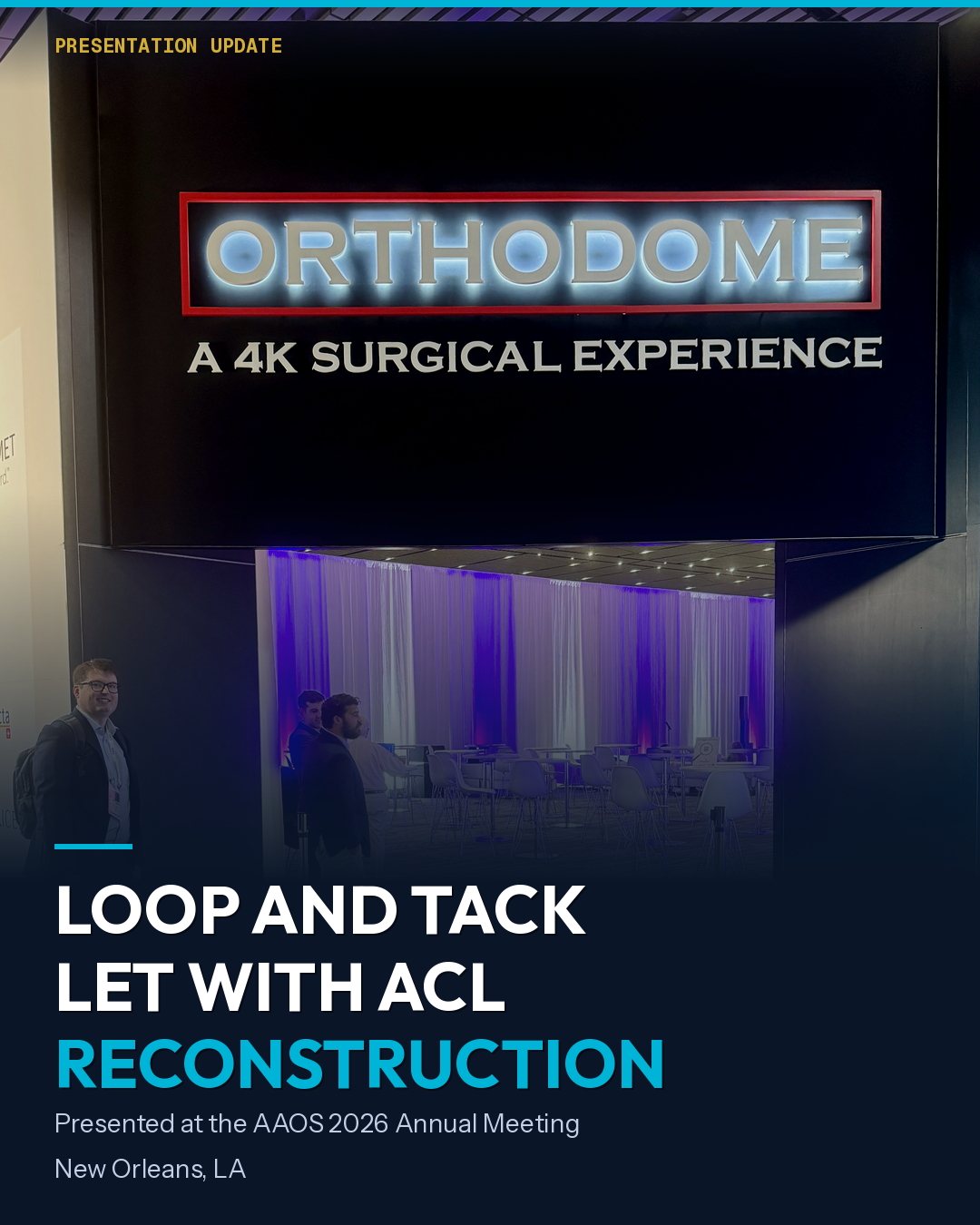
One of the highlights of this year’s AAOS Annual Meeting in New Orleans was presenting our technique for ACL reconstruction utilizing all-suture button femoral fixation with loop and tack lateral extra-articular tenodesis in the Orthopaedic Video Theater. Tommy Drazick, MD, our orthopaedic research fellow, led the presentation of our narrated 4K surgical technique video. OVT is one of the premier presentation formats at AAOS, with accepted videos eligible for publication in the Journal of the AAOS and continuing medical education designation.
Lateral extra-articular tenodesis has gained significant traction as an adjunct to ACL reconstruction, particularly for patients with higher risk factors for re-tear. The landmark STABILITY trial demonstrated that adding LET to hamstring autograft ACLR reduced graft rupture rates from 11% to 4% at two years, a finding that has shifted how many of us approach high-risk ACL cases.

The Loop and Tack Approach
What makes this technique distinctive is the fixation strategy on both sides of the reconstruction. On the femoral side, we use a novel all-suture cortical button, completely eliminating metal from ACL graft fixation. Traditional cortical buttons rely on a metal-suture interface that can be a point of weakness. The all-suture design removes that interface entirely, along with the clinical concerns associated with metal: hardware prominence, soft-tissue irritation, and metal sensitivity. Equally important, the all-suture button produces no artifact on postoperative MRI, allowing for reliable long-term graft surveillance. The implant is radiopaque for intraoperative confirmation and can be reshaped to sit low-profile against the femoral cortex. We recently published this technique in Arthroscopy Techniques (Richman, Hop, McGinley, Burnham, Mitchell, Krych, Frank, 2025).
For the LET component, we use an Arthrex double-loaded knotless anchor with what we call the “loop and tack” method. Rather than simply looping both suture limbs over the graft and tensioning them down, one limb is passed through the graft with a free needle and then looped back around, creating a rip-stop effect. This provides stronger fixation and more precise tensioning of the tenodesis compared to a standard looping technique.

The loop and tack concept originated with Dr. Adam Anz at the Andrews Research & Education Foundation in Gulf Breeze, FL, where it was initially applied to MPFL and posterolateral corner reconstruction. We adapted the approach for LET fixation alongside ACL reconstruction, and the result is a combined procedure that minimizes hardware while maintaining reliable graft security. For younger athletes who will be putting significant demands on their knee for decades, this kind of fixation refinement matters.
About Tommy Drazick, MD
Drazick came to Ochsner-Andrews Sports Medicine Institute from the University of South Dakota Sanford School of Medicine, where he co-founded 3D-MEDICS, a nonprofit focused on 3D printing in medical education. His research on ACL tunnel orientation and anterolateral ligament reconstruction using 3D-CT modeling is directly relevant to the work we presented at OVT. A former Division 1 collegiate swimmer and Phi Beta Kappa member, Drazick has presented research at conferences across three continents. We are fortunate to have him on our team, and this presentation is a well-earned reflection of his dedication.
The AAOS 2026 Annual Meeting ran March 2 through 6 at the Morial Convention Center in New Orleans, bringing together thousands of orthopedic surgeons for education, research presentations, and hands-on learning.