
I had the privilege of presenting on surgical repair of partial thickness patellar tendon injuries at the SEC Sports Medicine Symposium (SOA at the SEC) in Nashville this past week. The conference brought together team physicians, athletic trainers, and sports medicine specialists from across the Southeastern Conference, and the focus was on the real challenges of keeping elite athletes healthy and competing.
Patellar tendon pathology is more common than most people realize. Up to 55% of elite basketball players are affected, and the consequences are significant: 53% of affected athletes retire from sport over 15-year follow-up. Basketball is the number one sport in study cohorts (28%), but any athlete in a jumping or cutting sport is at risk. The underlying process involves repetitive microinjury that progresses to mucoid degeneration and focal necrosis, and when a discrete tear plane develops, this is no longer tendinitis.
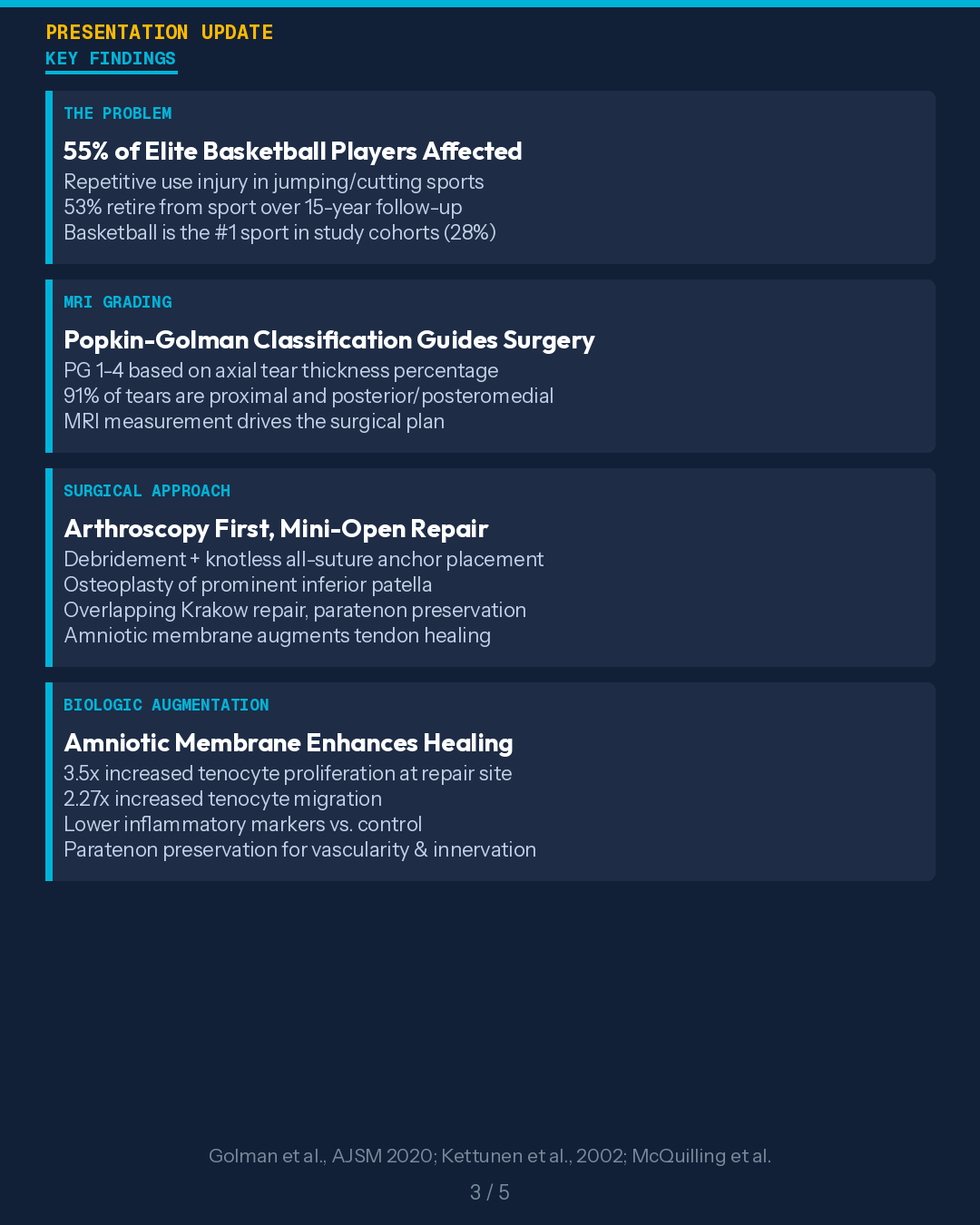
My presentation focused on how MRI measurement guides surgical decision-making. We use the Popkin-Golman classification (Golman et al., AJSM 2020) to grade tear severity on axial imaging. PG4 tears, those involving greater than 50% of the tendon thickness, with persistent sport-limiting pain despite compliant structured rehabilitation are candidates for surgical repair. Importantly, 91% of partial tears are proximal and posterior or posteromedial, which shapes the surgical approach.
The technique I presented combines arthroscopy-assisted evaluation with debridement and osteoplasty of the prominent inferior patella, followed by mini-open repair with knotless all-suture anchors, an overlapping Krakow suture configuration, and paratenon preservation. We augment the repair with amniotic membrane, which provides a biologic environment for healing: lower inflammatory markers at the repair site, 3.5x increased tenocyte proliferation, and 2.27x increased tenocyte migration.

The key message: partial thickness patellar tendon tears are structural injuries that require systematic evaluation, not just rest and time. When athletes fail structured rehabilitation and imaging confirms a discrete tear plane, surgical repair with osteoplasty and biologic augmentation offers a path back to competition.

Grateful for the opportunity to share this work with colleagues across the SEC, and for the continued support from Ochsner-Andrews Sports Medicine Institute in advancing evidence-based athlete care.