
Anterior cruciate ligament (ACL) injuries end athletic careers before they begin. A single non-contact ACL tear in basketball, soccer, or football can sideline an athlete for 9-12 months and carries a significant risk of re-injury after return to sport. The sobering reality: up to 20% of athletes who tear their ACL will suffer a second tear within two years of coming back to competition. Yet the overwhelming majority of these injuries are preventable.
Dr. Burnham’s research at the Ochsner-Andrews Sports Medicine Institute, combined with decades of scientific evidence, demonstrates that structured ACL prevention programs reduce injury risk by 25-33% in young athletes. For female athletes, who face 2 to 8 times higher risk than males, prevention programs can reduce injuries by up to 50%. This comprehensive guide outlines the evidence-based ACL prevention exercises and screening protocols that keep athletes healthy, build long-term athletic capacity, and establish the neuromuscular foundation required to compete at the highest levels.
In This Article
Why ACL Prevention Matters
The ACL is the primary stabilizer of the knee during cutting, pivoting, and deceleration. When it tears, the consequences extend far beyond the immediate surgery and rehabilitation. An ACL rupture interrupts an athlete’s competitive trajectory, delays college recruitment, and carries lifelong implications for knee health.
The financial and physical costs are staggering. ACL reconstruction in the United States costs $17,000 to $25,000 per surgery. The psychological impact is equally significant: fear of re-injury, loss of athletic identity, and the extended 12-month return-to-sport timeline create barriers that many young athletes never fully overcome.
What makes ACL injuries particularly tragic is their preventability. Multiple systematic reviews and meta-analyses have demonstrated that neuromuscular training programs reduce ACL injury risk by 25-33% across all ages and sports. The FIFA 11+ program, adopted by soccer federations worldwide, reduced injury rates in youth players by 41%. These are not small margins. In a youth soccer league with 500 athletes, a 30% reduction in ACL injuries means preventing 15-20 career-altering injuries per season.
Prevention also establishes the athletic foundation for long-term performance. Exercises that strengthen the hip and core, improve landing mechanics, and develop proprioception do not just prevent injuries. They enhance speed, explosive power, and agility. Athletes who invest in prevention programs become more resilient, more powerful, and more durable competitors.
Who Is at Risk?
ACL injury risk depends on a combination of non-modifiable factors (genetics, anatomy, sex) and modifiable factors (strength, neuromuscular control, training load). Understanding which athletes face elevated risk allows programs in Baton Rouge, Louisiana, and across the nation to target prevention efforts strategically.
Non-Modifiable Risk Factors:
- Female sex. Females suffer ACL injuries at 2 to 8 times the rate of males in the same sport. The risk elevation persists from age 13 through adulthood. Research by Pfeiffer and Burnham published in the Journal of Bone and Joint Surgery demonstrated that females exhibit greater rotatory knee laxity and altered hip external rotation patterns during landing, creating a biomechanical vulnerability that males do not share.
- Femoral notch anatomy. Narrowing of the intercondylar notch, a bony groove that houses the ACL, increases injury risk. Notch width has strong genetic determination.
- Generalized ligamentous laxity. Athletes with naturally loose joints and hypermobility face higher ACL rupture risk.
- Hormonal factors. Evidence suggests that fluctuations in estrogen and progesterone across the menstrual cycle may influence tissue stiffness and neuromuscular control, though this area remains an active research frontier.
Modifiable Risk Factors (Addressable via Prevention):
- Hip and glute weakness. Inadequate hip strength forces the knee to work in compromised positions, increasing ACL stress during cutting and landing.
- Core instability. A weak core fails to stabilize the pelvis during dynamic movements, cascading destabilization down the kinetic chain to the knee.
- Poor landing mechanics. Athletes who land with a straight knee (rather than a bent knee), inward knee collapse (valgus), or excessive forward trunk lean place enormous stress on the ACL during deceleration.
- Deficient proprioception. Loss of spatial awareness and balance control increases the likelihood of ankle inversion injuries that secondarily stress the knee, and limits the ability to sense and correct unstable knee positions in real time.
- Inadequate agility and deceleration training. Sport-specific cutting and stopping require neuromuscular adaptation. Athletes who never train these movements carry unprepared tissues into competition.
- Muscle imbalances. Quadriceps dominance (strong quads, weak hamstrings) creates an imbalance that increases ACL loading during deceleration. The hamstrings provide critical dynamic stability to the knee during the final phase of landing.
- High training loads without adequate recovery. Rapid increases in training volume, high-impact activity without strength foundation, and insufficient recovery elevate injury risk. Tissue adaptation lags behind activity demand.
The good news: every modifiable risk factor can be addressed with a structured prevention program. Athletes at higher risk (female athletes, those with ligamentous laxity, or those recovering from prior injury) benefit most from systematic, long-term prevention training.
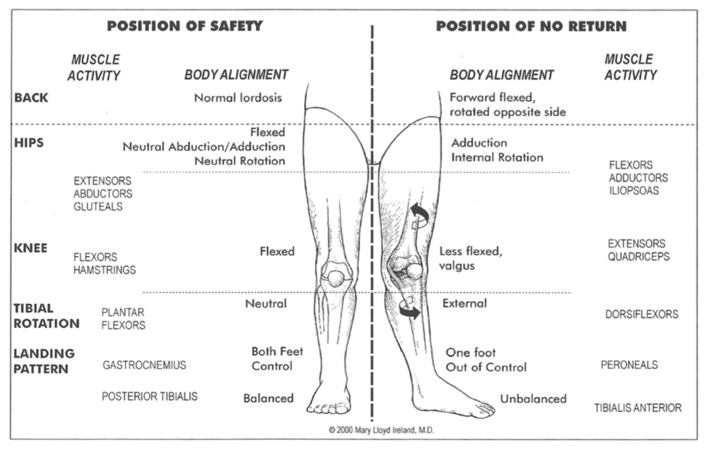
Key Components of an ACL Prevention Program
Effective ACL prevention is multimodal. A program targeting only strength, without attention to landing mechanics or proprioception, will not achieve the full 25-33% risk reduction. The evidence supports a program that integrates five pillars:
1. Hip and Glute Strengthening
The gluteus maximus and gluteus medius are the foundation of lower-body stability. During landing and cutting, strong glutes stabilize the pelvis, preventing pelvic drop and the cascade of knee valgus that follows. Research by Dr. Burnham demonstrates that female athletes who develop gluteal strength equivalent to their male counterparts show dramatically reduced ACL injury rates.
2. Core Stability and Trunk Control
A stable core prevents forward trunk lean and pelvic rotation during deceleration. This stability allows the lower extremities to function in biomechanically advantageous positions. Core endurance (not peak strength) is the relevant measure, as competition requires sustained stability over 60-90 minutes.
3. Plyometric Training and Landing Mechanics
Plyometric exercises teach the neuromuscular system to absorb and redirect force. Proper landing mechanics (bent knees, neutral knee alignment, stable trunk) must be practiced repeatedly until they become automatic. This training should include sport-specific landing patterns (single-leg landings in soccer, multi-directional landings in basketball) to ensure transfer to competition.
4. Balance and Proprioception
Single-leg balance exercises and proprioceptive training on unstable surfaces (balance boards, foam pads) awaken the deep stabilizers of the ankle and knee, improving the sensory feedback that guides movement. Proprioception training is particularly valuable for athletes with prior ankle injuries.
5. Agility and Deceleration
Sport-specific cutting and stopping patterns must be trained to develop the neuromuscular adaptations required to execute these movements safely at high speeds. Agility training should progress from controlled environments (cones in straight lines) to sport-specific scenarios (defender closing in, ball in flight) to competitive simulation.
The combination of these five elements creates the complete neuromuscular training stimulus that research demonstrates can prevent ACL injuries.

ACL Prevention Exercises by Category
Hip and Glute Strengthening Exercises
The hip abductors and extensors are the primary deficient muscles in athletes at high ACL risk. Strengthening these muscles is non-negotiable in any prevention program.
1. Single-Leg Glute Bridge
Lie on your back with one knee bent, foot flat on the floor 12 inches from your buttocks. Keep the other leg extended. Drive through your heel to lift your hips off the ground until your knee, hip, and shoulder form a straight line. Your extended leg should stay aligned with your torso. Hold for 2 seconds at the top, then lower slowly. Perform 12 repetitions per leg. This exercise develops gluteal strength in a closed-chain position that mimics standing stability.
2. Side-Lying Hip Abduction
Lie on your side with your lower leg bent for stability. Keep your upper leg straight and lift it toward the ceiling, leading with your heel. Your upper body should remain still, with the movement isolated to the hip. Perform 20 repetitions per leg. Add resistance by placing a resistance band above your knees once the movement becomes easy. This exercise targets the gluteus medius, the primary muscle responsible for preventing pelvic drop during single-leg activities.
3. Monster Walks
Place a resistance band around your thighs just above your knees. Assume a slight squat position with knees bent and hips back. Step forward, keeping your chest upright and core tight. Maintain tension on the band throughout. Perform 15 steps forward, 15 steps backward. This exercise develops hip abduction strength in a dynamic, functional position.
4. Clamshells
Lie on your side with knees bent 45 degrees and hips flexed 90 degrees. Keep your feet together and open your top knee, rotating your hip. Your feet should separate by 8-12 inches. Lower slowly and repeat. Perform 15 repetitions per leg. This exercise develops external hip rotator strength, a critical stabilizer for landing mechanics.
5. Lateral Band Walks
Place a resistance band around your thighs just above the knees. Assume a quarter-squat position. Step to the side while maintaining tension on the band, leading with one leg and allowing the other to follow. Perform 15 steps in each direction. This combines hip abduction strengthening with dynamic stability.
Core Stability Exercises
The core includes the abdominals, obliques, and spinal extensors. Core training should focus on endurance and stability under load rather than peak strength.
1. Plank Holds
Support yourself on your forearms and toes, maintaining a straight line from head to heels. Your core should be engaged so that your hips do not sag. Hold for 30-60 seconds. As you progress, increase hold duration to 90-120 seconds or add movement (shoulder taps, leg lifts) while holding the position. This is the foundational core exercise.
2. Side Plank Holds
Support yourself on your forearm and the outer edge of one foot, with your body forming a straight line. Perform 30-60 second holds per side. This exercise develops lateral core stability, critical for preventing trunk rotation during cutting movements.
3. Dead Bugs
Lie on your back with knees bent 90 degrees and hips flexed 90 degrees (shins parallel to the ground). Keep your lower back in contact with the floor. Slowly extend your right arm overhead while simultaneously extending your left leg straight. Return to start and alternate. Perform 10 repetitions per side. This exercise teaches core stability while the limbs move independently.
4. Bird Dogs
Begin on hands and knees with a neutral spine. Simultaneously extend your right arm forward and left leg backward until both are parallel to the ground. Return to start and alternate sides. Perform 10 repetitions per side. This exercise develops core endurance in a functional, anti-rotation position.
5. Pallof Press
Stand perpendicular to a cable machine or resistance band anchored at chest height. Hold the attachment at your chest with both hands. Press the handle away from your body, resisting rotation. Perform 12 repetitions per side. This develops anti-rotation core strength, essential for resisting the twisting forces generated during cutting and pivoting.
Plyometric and Landing Mechanics Exercises
Plyometric training teaches the neuromuscular system to absorb and redirect force efficiently. All plyometric exercises should emphasize proper landing mechanics: bent knees, neutral knee alignment, stable trunk, and a controlled deceleration phase.
1. Double-Leg Squat Jumps
Stand with feet shoulder-width apart. Descend into a squat, then explosively jump upward. Land softly with both feet, bend your knees to absorb impact, and control the descent. Perform 5-8 repetitions. Emphasize landing mechanics over jump height. This is the foundational plyometric exercise and must be mastered before progressing to single-leg variations.
2. Single-Leg Hop Holds
Stand on one leg. Hop forward, backward, and laterally in place. Land softly with your knee bent. Hold each landing for 1-2 seconds before the next hop. Perform 10 hops per direction per leg. This exercise develops proprioception and eccentric strength during dynamic single-leg activities.
3. Lateral Bounding
Starting on one leg, bound laterally to the opposite leg, landing with knee bent and core engaged. Continue bounding side to side. Perform 8-10 bounds per leg. This exercise mimics the lateral cutting movements common in soccer, basketball, and field sports.
4. 45-Degree Deceleration Hops
Set up cones in a 45-degree angle pattern 6-12 inches apart. Hop along the diagonal line, landing with control and bent knees. Perform 2-3 sets of 10 hops per leg. This sport-specific plyometric exercise trains the deceleration pattern required for directional changes.
5. Box Jumps with Soft Landings
Stand facing a box 12-24 inches in height. Jump onto the box, landing with bent knees and stable trunk. Step down (do not jump down) and repeat. Perform 5-8 repetitions. Focus on landing mechanics rather than box height. This exercise develops concentric power while training deceleration control.
Balance and Proprioception Exercises
Balance training awakens the deep stabilizers of the ankle and knee. These exercises should be performed daily and incorporated into warm-ups before sport.
1. Single-Leg Standing Balance
Stand on one leg for 30-60 seconds, keeping your other knee bent 90 degrees. Keep your standing knee slightly bent. Look straight ahead and maintain an upright posture. Perform 30-60 second holds per leg. Progress by closing your eyes or standing on a foam pad.
2. Single-Leg Stance with Arm Movement
Stand on one leg and perform controlled arm movements (circles, diagonal reaches) while maintaining balance. Perform 30-60 second bouts per leg. Adding arm movement increases core demand and mimics the demands of sport-specific activities.
3. Balance Board Training
Stand on a balance board on one or both legs. Maintain stability as the surface tilts and moves. Perform 1-2 minute bouts. This exercise develops proprioceptive feedback from the ankle and knee, critical for injury prevention.
4. Tandem Walking
Walk in a straight line, placing one foot directly in front of the other (heel-to-toe) as if walking a tightrope. Perform 20-30 feet forward and backward. This trains proprioception and dynamic balance in a functional movement pattern.
5. Single-Leg Lateral Band Walks on Unstable Surface
Place a resistance band around your thighs. Stand on one leg on a foam pad or balance board. Step laterally, maintaining balance on the unstable surface while resisting band tension. Perform 10-15 steps per leg. This combines proprioceptive challenge with hip strengthening.
Agility and Deceleration Exercises
Sport-specific agility training is crucial for transferring prevention benefits to competitive performance. These exercises should mimic the cutting, stopping, and direction-changing patterns required in the athlete’s sport.
1. T-Drill
Set up four cones in a T pattern: one at the origin, one 10 yards forward, and two additional cones 5 yards to each side at the far cone. Start at the origin, sprint forward to the far cone, shuffle laterally to one side cone, shuffle to the opposite side cone, shuffle back to center, and backpedal to the origin. Perform 3-4 repetitions with 60-90 second rest between. Time yourself to track improvement. This drill develops multi-directional agility and deceleration control.
2. 5-10-5 Shuttle
Set up cones 5 yards apart in a line. Start at the center cone. Sprint 5 yards to one cone, plant and cut, sprint 10 yards to the opposite cone, plant and cut, and sprint 5 yards back to center. Perform 4-6 repetitions per side with 90-second rest periods. This drill emphasizes the plant-and-cut maneuver common in multi-directional sports.
3. Zigzag Running
Set up 5-6 cones in a zigzag pattern 10 feet apart. Run through the cones, planting your outside foot at each direction change and accelerating to the next cone. Perform 2-3 passes with 60-second rest between. This drill develops sport-specific cutting mechanics at increasing speeds.
4. Box Ladder Lateral Steps
Stand outside a ladder. Step laterally through each rung of the ladder, maintaining an athletic stance and quick foot cadence. Perform 2-3 passes through the ladder. This develops lateral quickness and foot coordination required in soccer and basketball.
5. Sport-Specific Deceleration Drills
For soccer: practice stopping and cutting when the ball is passed or when closing on an opponent. For basketball: practice cutting and stopping off a pass reception. For football: practice breaking down and plant-and-cut movement when receiving the ball at speed. These drills should replicate the exact environmental and decision-making demands of competition.
How to Screen for ACL Injury Risk
Before launching a prevention program, athletes should be screened for movement deficits and risk factors. Screening identifies individuals at highest risk and allows coaches and athletic trainers to tailor prevention interventions. At the Ochsner-Andrews Sports Medicine Institute, the screening protocol includes several evidence-based assessments.
The Single-Leg Squat Descent (SLSD) Test
The SLSD test assesses lower-extremity movement quality during a functional, sport-relevant task. The athlete stands on one leg and slowly descends into a squat while keeping the opposite leg elevated. Assessors observe for key movement faults: inward knee collapse (dynamic valgus), pelvic drop, forward trunk lean, and foot pronation. Significant deficits in any of these areas flag elevated ACL risk. Research demonstrates that athletes with poor SLSD mechanics are at increased risk for ACL injury.
Hop Test Battery
The single-leg hop for distance, triple hop for distance, crossover hop, and Y-balance test quantify lower-extremity power, strength, and proprioception. Hop distances can be compared between legs (symmetry index). A limb with >90% of the opposite leg’s distance is considered normal; <85% suggests deficiency. Dr. Burnham has published extensively on hop test performance as a return-to-play criterion, and the same principles apply to initial screening. Athletes with bilateral strength asymmetries should undergo targeted strengthening before returning to sport or beginning a prevention program.
Functional Movement Screen (FMS)
The FMS is a battery of seven fundamental movement patterns (deep squat, hurdle step, in-line lunge, shoulder mobility, active straight-leg raise, trunk stability push-up, rotary stability). Each pattern is scored 0-3 based on whether the athlete can execute it with proper form. A composite FMS score of less than 14 out of 21 is associated with elevated injury risk. The FMS is particularly valuable for identifying movement asymmetries and compensatory patterns that predispose to injury.
Hip Strength Assessment
Handheld dynamometry or resistance testing of hip abduction and external rotation quantifies gluteal strength. Weakness in either plane (particularly gluteus medius abduction strength less than 80% of body weight) flags a critical deficiency that must be addressed via targeted strength training.
Y-Balance Test
The Y-Balance test assesses dynamic balance and proprioception. The athlete stands on one leg and reaches as far as possible in three directions (anterior, posterolateral, posteromedial) while maintaining balance. Asymmetries between the stance leg and reach distance, or between legs, indicate proprioceptive deficits or strength imbalances that warrant prevention focus.
A comprehensive screening is not required before beginning a general prevention program. However, athletes identified as high-risk (female athletes, those with prior injuries, those participating in cutting sports) benefit from formal screening to identify specific deficits that should be prioritized.
Building Your Prevention Program
Effective prevention is a long-term commitment. A single week of training provides no protection. Athletes should integrate prevention into their routine starting in the off-season and maintaining it year-round.
Frequency: 3-4 Days Per Week
The evidence supporting 25-33% injury reduction typically requires a minimum of three 20-30 minute sessions per week, or approximately 90-120 minutes per week of structured ACL prevention training. Ideally, this training should be distributed throughout the week (Monday, Wednesday, Friday, or Monday-Tuesday-Thursday-Friday) to allow adequate recovery between sessions. Some athletes, particularly those with identified risk factors, may benefit from 4-5 sessions per week.
Duration: 20-30 Minutes Per Session
An effective session includes a 5-10 minute warm-up, 10-15 minutes of strength and proprioceptive exercises, and 5-10 minutes of plyometric and agility training. Sessions should be structured to allow adequate recovery between high-intensity efforts (plyometrics, agility drills). Complete fatigue blunts the neuromuscular adaptation that prevention training aims to create.
Program Structure: Sample Week
Monday: Hip Strength and Core Stability (3×12 lateral band walks, 2×30-second planks, 3×10 dead bugs per side, 3×15 side-lying hip abductions, 3×8 double-leg squat jumps)
Tuesday: Balance and Proprioception (2×60-second single-leg stance per leg, 3×15 single-leg hops per direction per leg, 2 minutes balance board work per leg)
Thursday: Plyometric and Agility Training (5×5 yard T-drill, 3×5-10-5 shuttle per side, 3×8 single-leg hop holds per leg, 3×5-8 box jumps)
Saturday: Full-Body Prevention Session (1×30-second plank, 2×15 single-leg glute bridges per leg, 3×15 monster walks, 3×8 lateral bounds per leg, 2×60-second single-leg balance per leg)
Progression and Periodization
Athletes should progress exercises every 2-4 weeks by increasing repetitions, duration, resistance, or difficulty. Early in the season (weeks 1-4), emphasize strength and proprioceptive foundation. Mid-season (weeks 5-12), integrate higher-volume plyometric and agility training. Late season (weeks 13+), maintain strength and proprioception while emphasizing sport-specific agility. Periodization ensures continued adaptation and prevents training plateaus.
Adherence and Integration
The most effective prevention program is one the athlete will actually perform. Prevention training should be integrated into team warm-ups, conducted in group settings when possible, and made a standard part of the team culture rather than an individual responsibility. Coaches who emphasize injury prevention create accountability and sustained adherence. Programs conducted in laboratory settings or as individual homework show lower compliance rates than team-integrated programs.
Long-Term Timeline
Prevention programs should begin 4-6 weeks before the competitive season and continue throughout the season and off-season. Young athletes should maintain foundational prevention work year-round. A 12-month prevention commitment yields the greatest injury risk reduction. Athletes who drop prevention training during the season, or who stop prevention after one season, lose the protective adaptations, placing themselves at baseline risk again.
ACL Prevention for Female Athletes
Female athletes sustain ACL injuries at 2 to 8 times the rate of males in equivalent sports. This disparity is not due to increased contact or exposure; it reflects biomechanical and neuromuscular differences that predispose females to ACL injury at a fundamental physiological level.
Why Female Athletes Are at Higher Risk
Research by Pfeiffer and Burnham published in the Knee Surgery, Sports Traumatology, Arthroscopy journal demonstrated that female athletes exhibit significantly greater rotatory knee laxity (the amount of tibial rotation relative to the femur) compared to males. Additionally, females show different landing mechanics: less hip flexion, less knee flexion, and greater forward trunk lean during deceleration. Females also demonstrate greater Q-angle (the angle formed by the quadriceps and patellar tendon), which creates a more outward vector of force during knee loading. The combination of greater laxity and altered landing mechanics creates a perfect storm of ACL injury risk.
Hormonal factors may also play a role. Some research suggests that estrogen-mediated changes in ligament stiffness may increase ACL laxity during specific phases of the menstrual cycle, though this remains a developing area of research and does not account for the entire sex-based disparity.
Sex-Specific Prevention Strategies
Female athletes should prioritize hip abduction and external rotation strength, with particular emphasis on gluteus medius development. Research demonstrates that female athletes who achieve gluteal strength equivalent to male peers show marked reduction in ACL injury rates. Hip strengthening should be emphasized even more than for male athletes, making it the primary focus of a female-athlete prevention program.
Female athletes should also place heightened emphasis on controlled landing mechanics. Video analysis of landings, coached feedback on knee bend and trunk position, and plyometric training should all be emphasized. The transition from two-leg to single-leg activities requires extra attention in female athletes, as asymmetries are often more pronounced.
Increasing Female Athlete Engagement
Female athletes often receive less sports medicine resources and attention than male counterparts at the youth level. Coaching staff should allocate equal time and emphasis to female athlete injury prevention. Research shows that female athletes respond excellently to prevention training and show the greatest injury risk reduction when prevention programs are structured and consistently implemented. Investment in female athlete injury prevention yields substantial returns in player availability and team performance.
When to See a Sports Medicine Specialist
While the prevention exercises outlined above are safe for self-directed implementation, certain scenarios warrant professional evaluation by a sports medicine physician or athletic trainer.
Schedule an appointment if you experience:
- Knee pain or swelling that persists beyond a few days of rest, ice, compression, and elevation
- Knee instability or a sensation that the knee gives way, particularly during cutting or pivoting movements
- Inability to perform basic movement tasks without pain or apprehension
- Significant hip, knee, or ankle asymmetries identified during screening assessments
- Prior ACL injury or family history of ACL tears (significantly elevated re-injury risk)
- Prior ankle sprains or chronic ankle instability (impacts proprioception and predisposes to knee injury)
- Return to sport after any significant lower-extremity injury (ensures adequate strength and proprioception before full participation)
Dr. Burnham and the team at the Ochsner-Andrews Sports Medicine Institute can perform comprehensive movement screening, quantify ACL injury risk, and develop individualized prevention programs tailored to your sport and identified deficits. The comprehensive ACL reconstruction guide provides more information on surgical treatment if prevention fails and injury occurs.
The Bottom Line
ACL injuries are largely preventable through structured neuromuscular training. A commitment to 3-4 sessions per week of strength, plyometric, proprioceptive, and agility training can reduce ACL injury risk by 25-33% in young athletes. Female athletes, who face the highest baseline risk, show the greatest protective benefit from prevention programs and should prioritize hip strengthening and landing mechanics.
Prevention training is not a burden imposed on athletes. It builds speed, explosive power, resilience, and durability that enhance athletic performance across all sports. Athletes who invest in prevention during their competitive years build movement patterns and strength capacity that protect their knees for a lifetime. The investment in prevention today is the insurance policy against career-ending injury tomorrow.
About the Author
Jeremy M. Burnham, MD is a board-certified orthopedic surgeon and Director of Sports Medicine at Ochsner-Andrews Sports Medicine Institute in Baton Rouge, Louisiana. Following his orthopedic surgery residency at the University of Kentucky, he completed his sports medicine fellowship at the University of Pittsburgh Medical Center (UPMC), where he trained under the late Dr. Freddie Fu, a pioneer of anatomic ACL reconstruction, Dr. James Bradley, a renowned sports medicine surgeon and longtime professional team orthopedist, and Dr. Volker Musahl, an internationally recognized ACL surgeon and researcher. His team physician experience spans professional sports teams, the University of Pittsburgh, and Southern University. With 127 peer-reviewed publications, book chapters, and scientific presentations, Dr. Burnham is the most published ACL surgeon in Louisiana. His research focuses on ACL injury prevention, advancing ACL reconstruction, optimizing return-to-sport outcomes, and pioneering neuromuscular training programs to keep young athletes in Louisiana safe. He serves as a site principal investigator for two federally funded clinical trials (NIH STABILITY 2 and Department of Defense STaR Trial). View full credentials and publications.
References
- Burnham JM, Murrell T, Drazick T, et al. Current concepts in hip and core assessment and training for athletes with anterior cruciate ligament injury. Int J Sports Phys Ther. 2026. PMID: 41635594
- Burnham JM. ACL rupture in the female athlete: epidemiology and mechanism of injury. Clin Sports Med. 2017;36(3):383-398. PMID: 28800733 https://doi.org/10.1016/j.csm.2017.02.001
- Pfeiffer RP, Burnham JM, Shafiq B, et al. Female sex as a risk factor for anterior cruciate ligament injury: association with femoral notch width, rotatory knee laxity, and hip external rotation. Knee Surg Sports Traumatol Arthrosc. 2017;26(3):737-745. PMID: 28823037 https://doi.org/10.1007/s00167-017-4713-5
- Myklebust G, Engebretsen L, Braekken IH, et al. Prevention of anterior cruciate ligament injuries in female team handball players: a prospective intervention study over three seasons. Clin J Sport Med. 2003;13(2):71-78. PMID: 12604941
- Hewett TE, Myer GD, Ford KR, et al. Biomechanical measures of neuromuscular control and valgus loading of the knee predict anterior cruciate ligament injury risk in female athletes: a prospective study. Am J Sports Med. 2005;33(4):492-501. PMID: 15722287
- Balsalobre-Fernández C, Romero-Rodríguez D. Injury prevention and performance enhancement through neuromuscular training in youth athletes. Strength Cond J. 2015;37(6):10-19. https://doi.org/10.1519/SSC.0000000000000170
- Mandelbaum BR, Silvers HJ, Watanabe DS, et al. Effectiveness of a neuromuscular and proprioceptive training program in preventing anterior cruciate ligament injuries in female athletes: 2-year follow-up. Am J Sports Med. 2005;33(7):1003-1010. PMID: 15888716
- Lian O, Pfeiffer RP, Burnham JM, et al. Knee rotatory laxity in athletes: a 10-year prospective study correlating anatomic factors and functional capacity. J Bone Joint Surg Am. 2020;102(8):698-706. PMID: 32334614
- Cerulli G, Benoit DL, Caraffa A, Ponteggia F. Proprioceptive training and prevention of anterior cruciate ligament injuries in soccer. J Orthop Sports Phys Ther. 2001;31(12):655-660. PMID: 11765668
Frequently Asked Questions
At what age should athletes start an ACL prevention program?
ACL prevention training should begin by age 12-13, before the rapid growth and neuromuscular development that occurs during puberty. Early implementation is particularly important for female athletes, who face the highest injury risk during late adolescence (ages 15-19). However, athletes of any age can benefit from prevention training. Even college-age and professional athletes who did not grow up with prevention training can reduce their injury risk through structured programs.
Can I prevent an ACL injury with training alone, or do I need to see a doctor first?
If you have no current knee pain, swelling, or instability, you can safely begin a general prevention program based on the exercises outlined in this guide. However, if you have a prior ACL injury, prior knee surgery, significant hip or ankle asymmetries, or any current knee symptoms, you should see a sports medicine physician or athletic trainer before beginning. They can screen for movement deficits, identify your specific risk factors, and tailor the program accordingly.
How long does it take to see results from prevention training?
Neuromuscular adaptations begin within 2-4 weeks of consistent training. However, the injury risk reduction studies that demonstrate 25-33% protection typically tracked athletes for a full season (8-12 weeks) or longer. Short-term compliance (2-4 weeks) provides some protection, but long-term commitment (3-6 months and beyond) provides maximal benefit. Prevention training is a long-term commitment, not a short-term intervention.
What should I do if I feel pain during prevention exercises?
Sharp or severe pain during prevention training is a red flag indicating something is wrong. Stop the exercise immediately and avoid that movement until you can see a sports medicine professional. Mild muscle soreness the day after a new or intense workout is normal and expected. However, joint pain, swelling, or instability sensation requires professional evaluation before continuing.
Do I need special equipment to do ACL prevention exercises?
Most ACL prevention exercises require minimal equipment. Resistance bands are inexpensive and universally available. Balance boards and foam pads are helpful but not essential (single-leg standing on a firm surface is an adequate alternative). Cones for agility drills can be improvised with anything 12 inches tall. Many athletes begin with bodyweight exercises and add equipment as they progress. Prevention training does not require expensive gym memberships or specialized facilities to be effective.