
Walk through any supplement aisle and the collagen marketing is unmistakable: radiant skin, reduced wrinkles, better hair and nails. The beauty industry has successfully claimed collagen as a cosmetic supplement, and that framing has stuck. But for orthopedic surgeons, athletic trainers, and physical therapists working with injured connective tissue every day, the most clinically interesting collagen research has nothing to do with skin at all.
Dr. Jeremy Burnham, orthopedic surgeon and sports medicine specialist at the Ochsner-Andrews Sports Medicine Institute in Baton Rouge, Louisiana, regularly discusses collagen supplementation with patients recovering from ACL surgery, managing Achilles tendinopathy, or loading tendons through athletic training. The reason is straightforward: Type I collagen makes up 70-80% of tendon dry weight and is the primary structural protein in ligaments and bone matrix. These are the tissues that fail in athletes and surgical patients, and a growing body of evidence suggests the timing and delivery of collagen supplementation may matter far more than the beauty industry has led most people to believe.
▶ In This Article
Why Collagen Matters for Tendons (Not Just Skin)
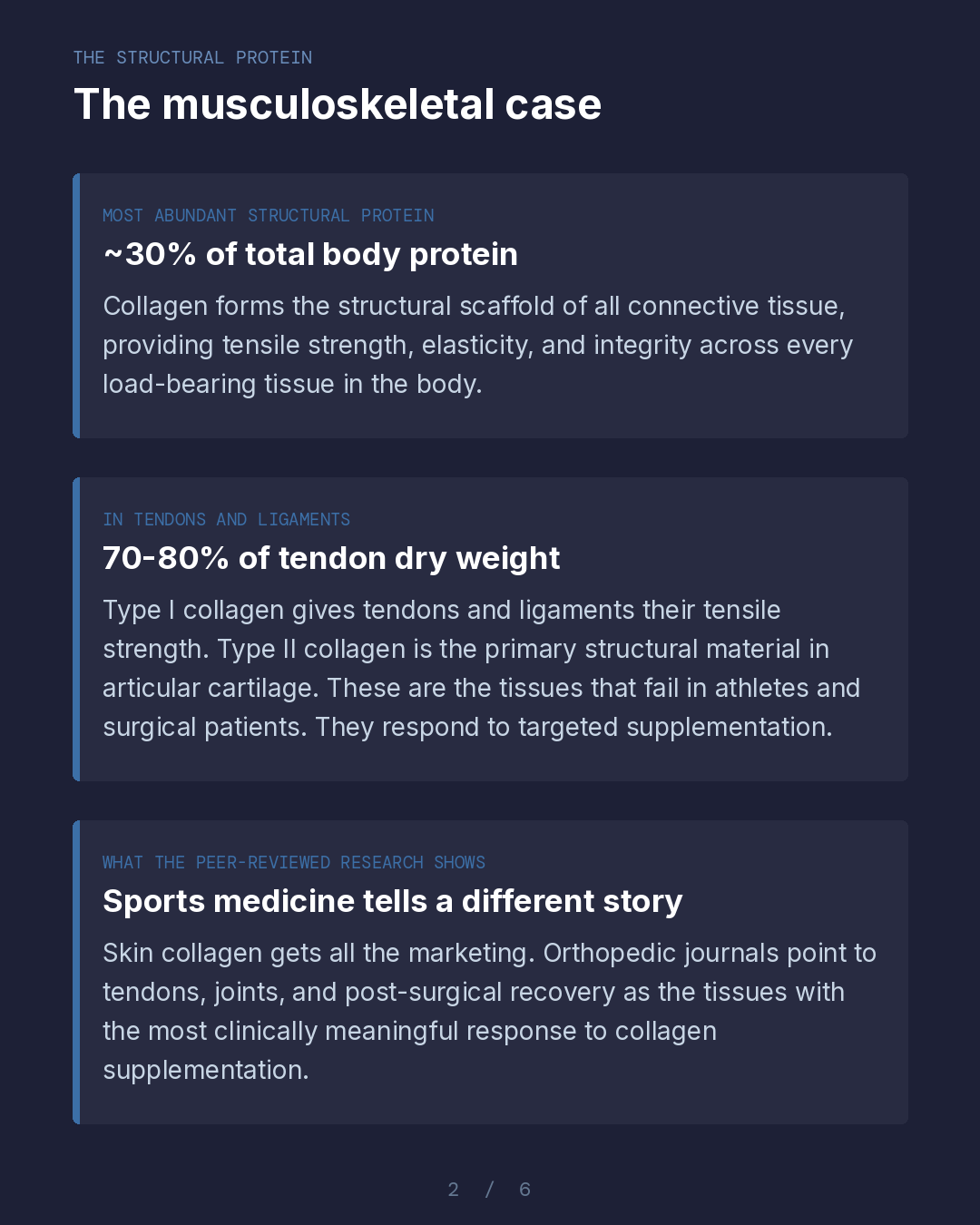
Collagen is the most abundant protein in the human body, and Type I collagen is its most common form. In skin, Type I collagen provides structure and elasticity. But Type I collagen is also the primary structural protein in tendons (comprising 70-80% of dry weight), ligaments, and the organic matrix of bone. These are load-bearing, mechanically demanding tissues that routinely sustain the most devastating injuries in sports medicine: ACL ruptures, Achilles tendon tears, rotator cuff failures, and patellar tendinopathy.
What makes tendons and ligaments particularly challenging from a healing standpoint is their notoriously poor vascularity. Blood supply to tendons is limited at baseline, which is why tendon injuries heal slowly, why chronic tendinopathy is so difficult to resolve, and why surgical repairs to these structures can take 9-12 months or longer to mature. Poor blood flow also means limited nutrient delivery, including delivery of the amino acid precursors needed for new collagen synthesis.
This is where the supplementation story becomes genuinely interesting from a biological standpoint.

The Timing Window: Why 60 Minutes Before Exercise
The most important and most overlooked variable in collagen supplementation is not dose, type, or brand. It is timing.
A landmark study by Shaw et al., published in the American Journal of Clinical Nutrition in 2017 (PMID 27852613), tested what happened when subjects consumed 15g of vitamin C-enriched gelatin 60 minutes before a period of intermittent exercise. Compared to placebo, the timed supplementation produced a two-fold increase in circulating markers of collagen synthesis. The placebo group, consuming the same supplement at a different time, showed no meaningful effect.
The mechanism makes biological sense. Exercise transiently increases blood flow to tendons. At rest, tendon perfusion is low. During and immediately after activity, that perfusion window opens briefly. If elevated collagen amino acids and vitamin C are circulating during that window, more of the substrate required for new collagen synthesis reaches the tissue. Take the supplement randomly, or at night before bed, and the timing of peak amino acid availability does not match the window of peak tissue perfusion. The biology simply does not work as efficiently.
The 60-minute pre-exercise timing is not arbitrary. It takes approximately 60 minutes for ingested gelatin or hydrolyzed collagen to be broken down and for circulating amino acid levels to reach their peak. By consuming the supplement one hour before activity, the patient arrives at peak tissue perfusion with peak amino acid availability already established.

What the Studies Actually Show
Three published studies form the core of the orthopedic evidence base for collagen supplementation timing and efficacy.
Shaw et al. (Am J Clin Nutr, 2017). The foundational timing study. Fifteen grams of vitamin C-enriched gelatin consumed 60 minutes before intermittent exercise produced a two-fold increase in serum markers of collagen synthesis compared to placebo. The study used functional engineering tests on ex vivo ligament tissue and demonstrated that the conditioned serum from timed-supplement subjects increased collagen synthesis and improved mechanical properties in tissue culture. PubMed PMID 27852613.
Praet et al. (Nutrients, 2019). A 24-week randomized controlled trial in athletes with chronic mid-portion Achilles tendinopathy. Subjects receiving specific collagen peptides combined with a targeted exercise program showed significantly greater improvements in pain and functional scores compared to placebo plus exercise. The study provides some of the best clinical outcome data available for a tendon indication. PubMed PMID 30609761.
Clark et al. (Curr Med Res Opin, 2008). A 24-week study in athletes with activity-related joint pain. Subjects receiving collagen hydrolysate showed significant improvements in pain scores compared to placebo, with the knees and hips showing the most consistent benefit. While older and focused on cartilage rather than tendon, this study contributes to the broader picture of collagen supporting connective tissue health under load. PubMed PMID 18416885.
Together, these studies suggest a consistent biological theme: collagen supplementation, properly timed and paired with physical activity, can increase circulating collagen synthesis markers and improve patient-reported outcomes in tendon and joint pathology.
The Evidence-Based Protocol
The protocol that most closely matches the available evidence, drawn from both the Shaw 2017 and Praet 2019 studies, consists of four variables:
Form: Hydrolyzed collagen (collagen peptides) or vitamin C-enriched gelatin. Hydrolyzed collagen is more bioavailable and is the form used in the Praet trial. Gelatin was used in the Shaw study and is less convenient but functional.
Dose: 15 grams per day. This is the dose used in the Shaw 2017 study and is consistent with the Praet protocol. Doses below 10g appear less effective; there is no established benefit to going above 20g daily.
Cofactor: 50 to 200mg of vitamin C, taken with the collagen. Vitamin C is required for the hydroxylation of proline and lysine residues in collagen molecules, a step catalyzed by prolyl and lysyl hydroxylases. Without adequate vitamin C, collagen cross-linking is incomplete and mechanical integrity is compromised. This is established biochemistry, not hypothesis.
Timing: 60 minutes before the activity most relevant to the target tissue: a training session, a physical therapy appointment, a return-to-sport workout. The supplement should be taken at a consistent time relative to activity every day, not randomly.
Duration: A minimum of 8 to 12 weeks. Connective tissue remodeling is slow. Tendons do not respond to supplementation in days or weeks the way muscle protein synthesis does after resistance training. Patients should set expectations accordingly: this is a months-long intervention, not a short-course treatment.
What to Look For in a Collagen Supplement
Not all collagen supplements are equal. For orthopedic and sports medicine applications, the key criteria are form (hydrolyzed collagen peptides, not gelatin or whole protein), dose (at least 10-15g per serving), and the inclusion of vitamin C as a cofactor.
Many products on the market are under-dosed, use whole collagen protein with lower bioavailability, or omit vitamin C entirely. The timing guidance above also assumes the patient is pairing the supplement with physical activity, which most commercial products do not mention.
For patients looking for a straightforward option that meets these criteria, Dr. Burnham recommends Vital Proteins Collagen Peptides (hydrolyzed, 20g collagen per serving, unflavored, easily mixed into water or juice with a separate vitamin C source). It is one of the most widely studied hydrolyzed collagen products and meets the dose and form requirements of the evidence-based protocol.
If choosing a product that already includes vitamin C, verify the dose is at least 50mg per serving. Lower amounts may not be sufficient for maximal collagen hydroxylation support.
Who Benefits Most
The collagen timing protocol is not limited to elite athletes. The mechanism applies to anyone who needs to support connective tissue under load, which includes a wider population than most people assume.
Athletes with tendinopathy. Achilles, patellar, and rotator cuff tendinopathy are among the most common chronic sports medicine conditions. The Praet 2019 trial specifically targeted mid-portion Achilles tendinopathy and found clinically meaningful improvements in pain and function. For patients who have failed rest, eccentric loading programs, or other conservative measures, adding a properly timed collagen protocol is a low-risk adjunct with biologically plausible benefit.
Patients recovering from ACL reconstruction. The graft used in ACL reconstruction, whether patellar tendon, hamstring, or quadriceps tendon autograft, undergoes a process called ligamentization after surgery: the graft progressively remodels from a tendon or tissue donor site into something that biologically resembles a ligament. This process is driven by collagen synthesis and remodeling and takes 12 to 24 months to complete. Supporting collagen synthesis during this window, particularly during early rehabilitation when physical therapy exercises create the exercise-induced perfusion window, is mechanistically rational. For more on ACL reconstruction and recovery, see Dr. Burnham’s ACL recovery timeline guide.
Patients recovering from other ligament and cartilage procedures. The same collagen synthesis rationale applies to any patient whose rehabilitation involves loading connective tissue: multiligament reconstructions, cartilage restoration procedures, meniscus repairs. These patients spend months in physical therapy performing precisely the kind of intermittent, low-to-moderate activity that creates the tendon perfusion window the Shaw study exploited.
Active adults with joint pain. The Clark 2008 study included athletes with activity-related knee and hip pain, not surgical patients. If a recreational runner, cyclist, or fitness athlete is managing joint discomfort during activity, the evidence profile for collagen supplementation is more credible than most over-the-counter joint supplements currently marketed for this indication.
Honest Caveats: What the Evidence Cannot Yet Confirm
The collagen timing and mechanism story is biologically compelling, and the existing studies are encouraging. But intellectual honesty requires acknowledging where the evidence falls short.
The supporting RCTs are small. Shaw 2017 used a crossover design with a limited sample size. The Praet 2019 Achilles tendinopathy RCT was similarly small. Clark 2008 is now nearly two decades old. Several studies in this space have been funded by collagen industry partners, which introduces the potential for publication bias and methodological choices that favor favorable results.
Perhaps more importantly, most studies measure surrogate endpoints, primarily circulating biomarkers of collagen synthesis such as PICP and serum hydroxyproline rather than clinical outcomes like return-to-sport rates, rerupture rates, or long-term tendon integrity on imaging. An increase in a collagen synthesis biomarker is biologically meaningful but is not the same as demonstrating improved ACL graft maturation rates or reduced Achilles tendinopathy recurrence at two years.
A systematic review published in Sports Medicine concluded that current evidence does not yet justify strong clinical recommendations for collagen supplementation in sports injuries. That conclusion is accurate. The mechanism is sound. The early clinical data is promising. The definitive clinical proof is still maturing.
The appropriate clinical frame for this supplement is not “proven treatment” but “mechanistically rational, low-risk adjunct with encouraging early data.” For patients who are already engaged in physical therapy or structured training and are willing to be consistent with the protocol for 8-12 weeks, the biological rationale is stronger than for almost any other supplement commonly recommended in this space.
About Dr. Jeremy Burnham
Dr. Jeremy Burnham is a board-certified orthopedic surgeon and sports medicine specialist at the Ochsner-Andrews Sports Medicine Institute in Baton Rouge, Louisiana. He specializes in ACL reconstruction, complex knee surgery, and return-to-sport rehabilitation, and serves as Site Principal Investigator for the NIH-funded STABILITY 2 Trial and the DoD-funded STaR Trial. He has authored more than 50 peer-reviewed publications in orthopedic surgery and sports medicine.
The Bottom Line
The beauty industry got to collagen first, and the skin marketing has dominated the conversation ever since. The orthopedic evidence, while still developing, points toward a different and arguably more clinically significant application: supporting the synthesis and remodeling of tendons, ligaments, and joint cartilage, which are the tissues most commonly damaged in athletes and surgical patients.
The critical variable is timing. Fifteen grams of hydrolyzed collagen with 50 to 200mg of vitamin C, taken 60 minutes before training or physical therapy, positions peak amino acid availability to coincide with the brief window of exercise-induced tendon perfusion. Without that timing, the supplement loses its primary biological advantage.
The evidence base is encouraging but not definitive. Supporting studies are small, some are industry-funded, and long-term clinical outcomes data is limited. What is sound is the mechanism: you are feeding a tissue that normally gets very little, at the moment it becomes briefly accessible. For patients managing tendinopathy or recovering from ligament surgery who want to know what supplements are worth understanding, the collagen timing protocol is the most biologically grounded option in the current literature.
Consistent with the protocol means daily, before activity, for at least 8 to 12 weeks. Inconsistent supplementation, random timing, or inadequate duration are the most common reasons patients do not see results. The biology requires patience.
References
- Shaw G, Lee-Barthel A, Ross ML, Wang B, Baar K. Vitamin C-enriched gelatin supplementation before intermittent activity augments collagen synthesis. Am J Clin Nutr. 2017;105(1):136-143. PMID: 27852613.
- Praet SFE, Purdam CR, Welvaert M, et al. Oral supplementation of specific collagen peptides combined with calf-strengthening exercises enhances function and reduces pain in Achilles tendinopathy patients. Nutrients. 2019;11(1):76. PMID: 30609761.
- Clark KL, Sebastianelli W, Flechsenhar KR, et al. 24-Week study on the use of collagen hydrolysate as a dietary supplement in athletes with activity-related joint pain. Curr Med Res Opin. 2008;24(5):1485-1496. PMID: 18416885.
What type of collagen supplement is best for tendon and joint recovery?
Hydrolyzed collagen peptides are the most bioavailable form for orthopedic and sports medicine applications. Hydrolyzed collagen has been broken into smaller peptide fragments that are more efficiently absorbed than whole collagen protein or non-hydrolyzed gelatin. Look for a product with at least 10-15g per serving and consider pairing it with 50-200mg of vitamin C if the product does not already include it, since vitamin C is essential for the collagen synthesis process.
Why does the timing of collagen supplementation matter?
Tendons have very limited blood flow at rest, which restricts delivery of nutrients including the amino acid precursors needed for collagen synthesis. Exercise transiently increases tendon blood flow, opening a brief window during which more substrate can reach the tissue. Research by Shaw et al. (Am J Clin Nutr, 2017) showed that taking collagen 60 minutes before exercise, so that circulating amino acid levels are at their peak when tissue perfusion increases, produced twice the collagen synthesis markers compared to placebo. Random timing or post-workout supplementation does not exploit this window.
Can collagen supplementation help with ACL recovery?
There is a mechanistically rational case for collagen supplementation during ACL recovery. After ACL reconstruction, the graft undergoes ligamentization, a months-long process in which the graft tissue remodels into something that biologically resembles a native ligament. This process depends on collagen synthesis and remodeling. Taking hydrolyzed collagen 60 minutes before physical therapy sessions, when rehabilitative exercises create the exercise-induced tendon perfusion window, may support this process. Direct clinical trials specifically in ACL reconstruction patients are still limited, but the biological mechanism is the same as in tendinopathy studies.
How long does it take for collagen supplementation to work for tendons and joints?
Connective tissue remodeling is a slow process. Unlike muscle, which can show measurable hypertrophy responses within weeks of resistance training, tendons and ligaments have slow turnover rates due to their limited vascularity. The Praet 2019 study on Achilles tendinopathy used a 24-week protocol. The Clark 2008 knee pain study ran 24 weeks as well. A minimum of 8-12 weeks of consistent daily supplementation, properly timed, is the standard recommendation before assessing whether the protocol is producing benefit. Patients who stop after 2-4 weeks are unlikely to see meaningful connective tissue changes.
Is it safe to take collagen with other supplements or medications?
Hydrolyzed collagen is generally considered safe and is well-tolerated in the doses used in clinical research (10-20g daily). It is a food-derived protein supplement without significant known drug interactions. The vitamin C cofactor is also safe at the doses recommended (50-200mg). Patients taking blood thinners, those with significant kidney disease, or those with known allergies to the source material (bovine, marine, or porcine) should discuss with their physician before starting. As with any supplement, patients should disclose use to their treating physician and physical therapist so it can be incorporated appropriately into their overall recovery plan.