
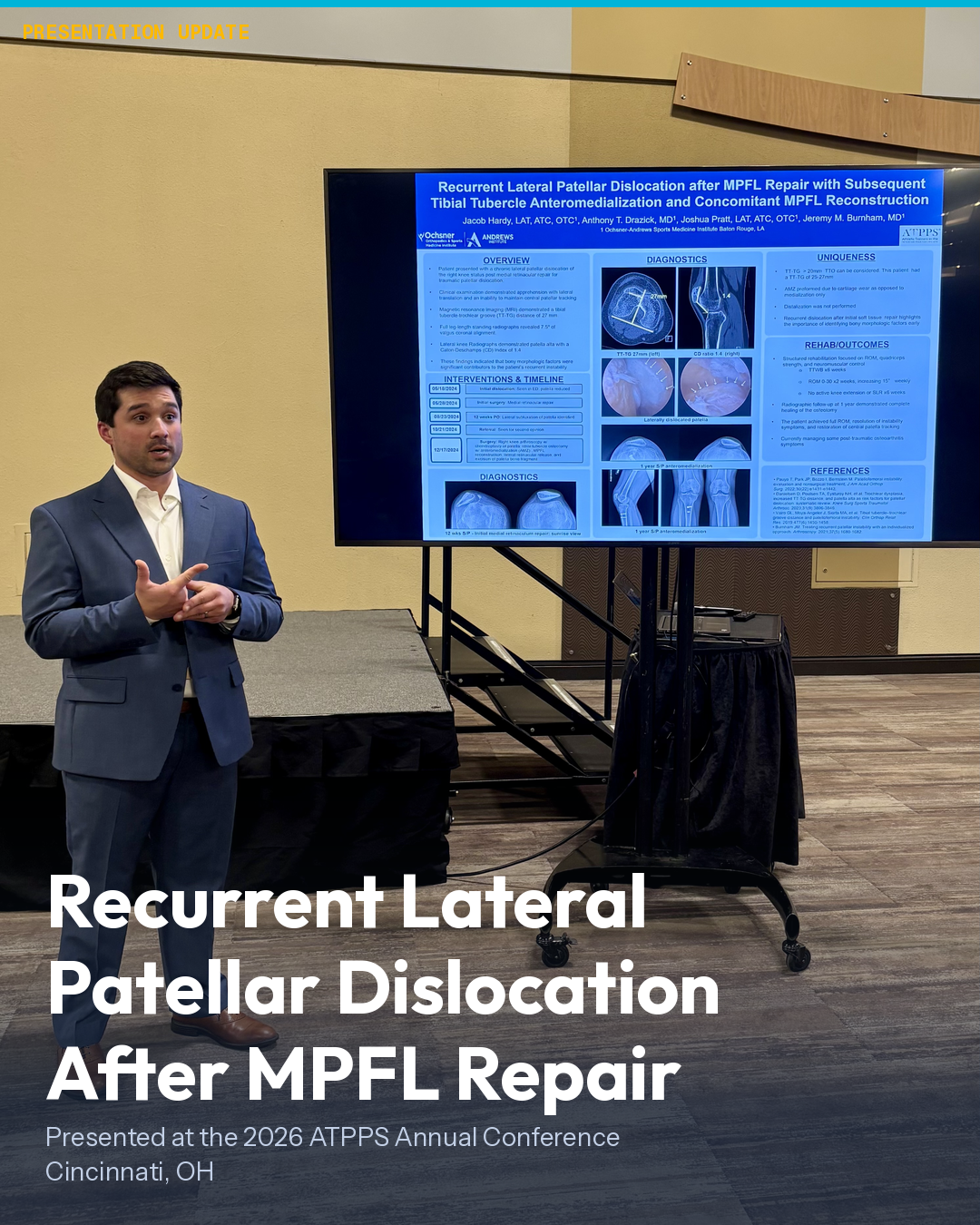
Jacob Hardy, ATC presented a compelling case at the 2026 ATPPS Annual Conference in Cincinnati that drives home a critical point in patellar instability surgery: soft tissue repair alone is not enough when the underlying bony anatomy is working against the patient.
The patient had undergone an MPFL (medial patellofemoral ligament) repair at another institution but returned with recurrent lateral patellar dislocations just four months later. Dr. Burnham’s workup revealed why the initial procedure failed.

The Workup
Advanced imaging told the story. The TT-TG (tibial tuberosity-trochlear groove) distance measured 27 mm, well into pathologic range. Valgus alignment sat at 7.5 degrees. The Caton-Deschamps Index came back at 1.4, confirming patella alta.
Put simply, the kneecap was sitting too high and tracking too far laterally, and no amount of soft tissue tightening was going to overcome those structural forces.

The Surgical Plan
Dr. Burnham performed a tibial tubercle anteromedialization to correct the TT-TG distance and improve patellar tracking geometry, combined with an MPFL reconstruction using allograft to restore the soft tissue restraint that had failed. Addressing both layers of the problem, bony and ligamentous, gave the patient the best shot at lasting stability.
The result: full range of motion restored, normal patellofemoral tracking, and complete bony healing at the osteotomy site.
The Takeaway
Patellar instability is not a one-size-fits-all problem. Every patient needs a full anatomic workup: TT-TG distance, trochlear geometry, patellar height, and lower extremity alignment. When those numbers are abnormal, the surgical plan has to address the bone, not just the ligament. Skip that step, and the kneecap will keep dislocating regardless of how well the soft tissue repair is done.
That is the message Jacob Hardy drove home in his presentation, and it reflects the approach Dr. Burnham takes with every patellar instability case at Ochsner-Andrews Sports Medicine Institute.
Jacob Hardy, ATC put together an excellent poster on this case alongside Tommy Drazick, MD and Joshua Pratt, ATC. The full case report is published in Clinical Practice in Athletic Training.
Related Reading
- MPFL Reconstruction Surgery (a comprehensive guide to medial patellofemoral ligament reconstruction)
- Patella Dislocation (Dislocated Kneecap) (understanding the anatomy and management of patellar instability)
- Tibial Tubercle Transfer (Osteotomy) (when bony correction is needed to restore patellar tracking)