
PRP (Platelet-Rich Plasma) is one of the most talked about treatments in orthopedics today. Patients ask me about it every week, and I understand why. The concept is appealing: concentrate the healing factors from your own blood and inject them where you need them. But as someone who teaches orthobiologics courses, administers PRP in the office, and reads the research closely, I think patients deserve an honest conversation about what the evidence actually supports, especially because the data has changed meaningfully in the last two years.
This is not an anti-PRP article. I use PRP selectively in my practice at Ochsner-Andrews Sports Medicine Institute, and I co-authored a book chapter on the clinical use of stem cells and platelet-rich plasma (Murphy, Gasparro, Pfeiffer, Burnham, Musahl, 2017). I also use leukocyte-poor PRP preparations (such as the Arthrex ACP system) in my office. Here is a condition-by-condition breakdown based on the latest evidence.
In This Article [show]
- Not All PRP Is the Same: LP-PRP vs LR-PRP
- Where PRP Works: Evidence-Supported Indications
- Formulation Matters: ACP, PRP+HA Synergy, and Joint Applications
- Where PRP Falls Short
- Emerging Frontiers: Platelet-Poor Plasma and Beyond
- My Approach to PRP in Practice
- The Bottom Line
- References
- Frequently Asked Questions
Not All PRP Is the Same: LP-PRP vs LR-PRP
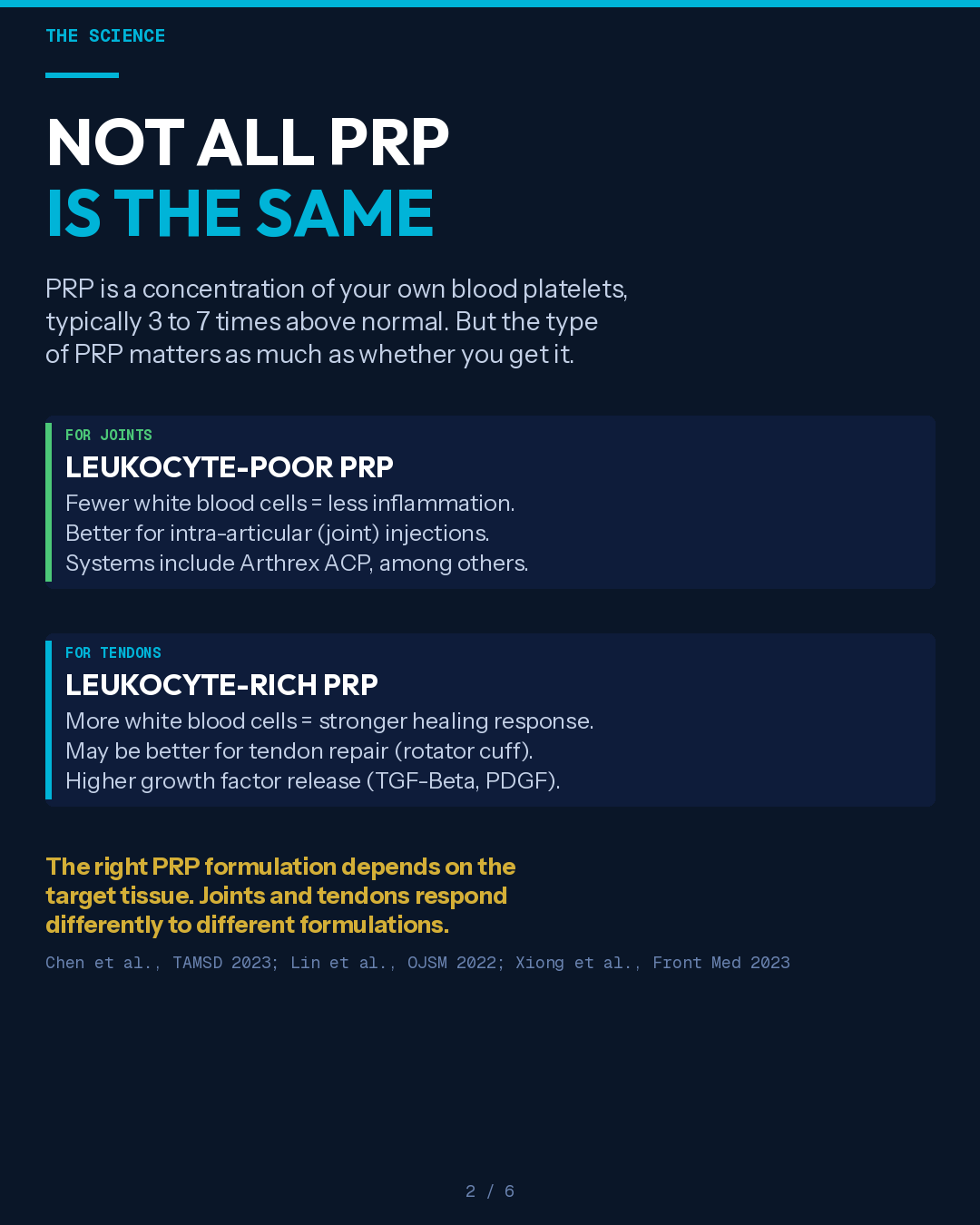
PRP is a concentration of your own blood platelets, typically 3 to 7 times above normal levels. A small blood draw is processed in a centrifuge to separate the platelet-rich layer, which is then injected into the treatment area. When activated, these platelets release growth factors including PDGF, TGF-Beta, VEGF, and IGF-1, molecules that play roles in cell growth, tissue repair, and blood vessel formation.
But here is what most patients are not told: not all PRP is the same. The two main categories are leukocyte-poor PRP (LP-PRP) and leukocyte-rich PRP (LR-PRP), and they behave differently in different tissues.
LP-PRP contains fewer white blood cells, which means less inflammation at the injection site. A 2023 meta-analysis of 24 RCTs found that LP-PRP was more effective than LR-PRP for reducing pain in osteoarthritis patients (Xiong et al., Frontiers in Medicine 2023). This makes LP-PRP the preferred formulation for intra-articular (joint) injections.
LR-PRP contains more white blood cells and releases higher levels of growth factors like TGF-Beta and PDGF. A laboratory study found LR-PRP stimulated greater tenocyte (tendon cell) proliferation than LP-PRP (Lin et al., Orthopaedic Journal of Sports Medicine 2022). This suggests LR-PRP may be better suited for tendon pathology like rotator cuff issues, though the clinical evidence is still evolving.
Where PRP Works: Evidence-Supported Indications
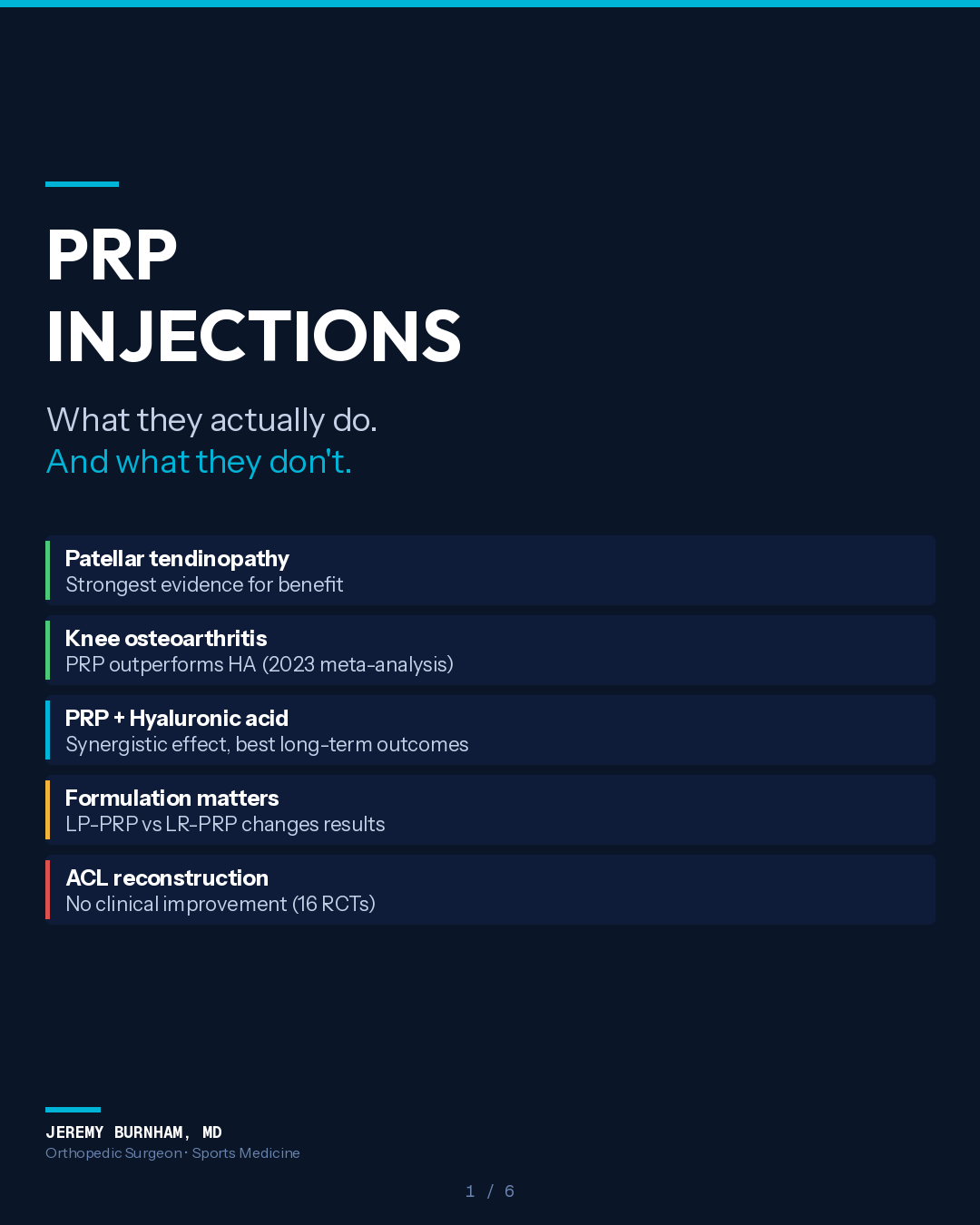
Knee osteoarthritis is where the biggest evidence shift has occurred. A 2023 meta-analysis of 30 articles involving 2,733 patients found PRP outperformed hyaluronic acid in both WOMAC and IKDC outcome scores. Importantly, LP-PRP showed better functional recovery than LR-PRP (Chen et al., Therapeutic Advances in Musculoskeletal Disease 2023). This is a meaningful update from earlier data that suggested PRP and HA were merely comparable. A separate 2025 meta-analysis of 28 RCTs (3,246 patients) confirmed PRP’s superior functional improvement over HA (Wang & Yao, European Journal of Medical Research 2025).
Patellar tendinopathy continues to have the strongest evidence base. A comprehensive systematic review in KSSTA examined 19 studies and found consistent benefit when PRP is used as conservative treatment for chronic patellar tendon pain (Filardo et al., KSSTA 2016). This is one of the indications where I am most confident recommending PRP to patients.
PRP combined with hyaluronic acid may offer the best long-term results for knee osteoarthritis. Cole et al. found that HA-PRP conjugates provide a synergistic effect, with LP-PRP formulations providing greater therapeutic relief (Gilat, Cole et al., International Orthopaedics 2020). A 2025 Bayesian network meta-analysis of 37 RCTs involving 5,089 patients ranked PRP+HA first for both pain relief and functional improvement at one year, ahead of PRP alone, HA alone, or corticosteroids (Gupta et al., Journal of Orthopaedic Surgery and Research 2025).

Formulation Matters: ACP, PRP+HA Synergy, and Joint Applications
The preparation system determines what product you actually receive. One example of a leukocyte-poor system is the Arthrex ACP (Autologous Conditioned Plasma) Double-Syringe system, which produces an LP-PRP concentrate at 2 to 3 times baseline platelet concentration. A prospective cohort study of 42 patients found clinical benefits at 6 months, with older age and higher platelet concentration predicting better outcomes (Selim et al., Cartilage 2025). This is the system I use in my office, though several other LP-PRP kits are available.
For hip osteoarthritis, the data is earlier-stage but suggestive. A systematic review and meta-analysis in AJSM found that LP-PRP was associated with a larger reduction in pain compared to LR-PRP for hip OA, and that a single injection outperformed multiple injections (Lim et al., American Journal of Sports Medicine 2022). However, another meta-analysis found PRP did not significantly reduce pain in hip OA compared to controls (Xiong et al., 2023). The evidence is mixed, and I would not call it definitive.
For the shoulder, PRP has shown benefit for rotator cuff tendinopathy in multiple studies. An editorial in Arthroscopy noted that PRP injections produced significant improvement in most patients with rotator cuff tendinopathy and may be more advantageous than corticosteroids because PRP is potentially anabolic while corticosteroids are catabolic for tendons (Hurley et al., Arthroscopy 2023). For shoulder applications, the LP-PRP vs LR-PRP question is less clear, with some lab evidence favoring LR-PRP for tendon healing. Limited clinical studies make it difficult to say definitively which formulation is optimal for the shoulder.
Where PRP Falls Short
ACL reconstruction remains the clearest case where PRP does not improve clinical outcomes. A systematic review of 16 randomized controlled trials involving 1,025 patients found no improvement in IKDC, Lysholm, or Tegner functional scores when PRP was added to ACL reconstruction. There was no improvement in knee laxity, range of motion, or pain scores either (Cao & Wan, Orthopaedic Surgery 2022). Some imaging studies showed changes in graft remodeling, but those changes did not translate into better function for patients.
The standardization problem continues to be the elephant in the room. At least 4 fundamentally different PRP formulations exist, and platelet concentration varies 1.6 to 4.4 fold between commercial preparation kits. Only 21% of published studies report all PRP preparation factors (Kramer & Keaney, 2018). This means when one study shows benefit and another does not, we often cannot determine whether the difference is the condition, the patient, or the product.
Emerging Frontiers: Platelet-Poor Plasma and Beyond
Platelet-poor plasma (PPP) is an emerging area to watch. PPP contains fewer platelets than PRP but retains many of the cytokines and growth factors. It also carries a lower risk of the inflammatory reaction that some patients experience with PRP. A 2025 review in Clinics in Sports Medicine described PPP as offering a lower risk of inflammation compared to standard PRP and suggested it may be a promising alternative for knee OA treatment (Chiari Gaggia et al., Clinics in Sports Medicine 2025). However, PPP remains investigational with no large-scale randomized controlled trials completed. An in vitro study found that PRP contained significantly higher levels of proliferative cytokines compared to PPP and was superior at stimulating chondrocyte proliferation (Riewruja et al., International Journal of Molecular Sciences 2022), suggesting PPP may not fully replace PRP but could serve a complementary role.
My Approach to PRP in Practice
I use PRP selectively where the evidence supports it, and I use the Arthrex ACP system because it produces a consistent leukocyte-poor preparation. For knee osteoarthritis, the data now favors PRP over hyaluronic acid alone, and I discuss the potential benefit of combining PRP with HA based on the synergy data. For chronic patellar tendon pain that has not responded to conservative management, PRP is a reasonable next step with strong data behind it. I do not routinely add PRP to ACL reconstruction because the randomized trial data does not support a clinical benefit.
PRP is safe. It is autologous (your own blood), and serious adverse events are essentially unreported across the literature. The most common side effects are injection site soreness and temporary swelling. But safety and efficacy are separate questions, and the type of PRP matters. If you are considering PRP, ask your provider which formulation they use and what the evidence says for your specific condition.
Jeremy Burnham, MD is a board-certified orthopedic surgeon and sports medicine specialist at Ochsner-Andrews Sports Medicine Institute in Baton Rouge, Louisiana. He co-authored “Current State for Clinical Use of Stem Cells and Platelet Rich Plasma” (ISAKOS, 2017) and has served as instructor and co-chair for orthobiologics courses at the Arthroscopy Association of North America (AANA). He uses the Arthrex ACP system for leukocyte-poor PRP in his clinical practice.
The Bottom Line
PRP is a safe, autologous treatment that has grown more evidence-based over the last several years. The most important update is that PRP, particularly leukocyte-poor formulations, now outperforms hyaluronic acid for knee osteoarthritis in multiple meta-analyses. Combining PRP with HA may be synergistic and produce the best long-term results. For patellar tendinopathy, the evidence remains strong. The Arthrex ACP system offers a reliable leukocyte-poor preparation with documented clinical benefits. For hip and shoulder applications, LP-PRP shows early promise but needs more research. For ACL reconstruction, the randomized trial data does not support adding PRP. And platelet-poor plasma is an emerging frontier worth watching. The bottom line: the type of PRP matters as much as whether you get it. If someone recommends PRP, ask which formulation and what the evidence says for your condition.
References
- Murphy C, Gasparro G, Pfeiffer T, Burnham JM, Musahl V. “Current State for Clinical Use of Stem Cells and Platelet Rich Plasma.” In: Gobbi A (Ed.), Bio-Orthopaedics: A New Approach. ISAKOS, 2017.
- Chen Z, et al. “Platelet-rich plasma versus hyaluronic acid for knee osteoarthritis: A systematic review and meta-analysis.” Therapeutic Advances in Musculoskeletal Disease, 2023. DOI
- Wang C, Yao B. “Efficacy and safety of platelet-rich plasma injections for the treatment of knee osteoarthritis.” European Journal of Medical Research, 2025. DOI
- Gupta N, et al. “Long-term effectiveness of intra-articular injectables in patients with knee osteoarthritis.” Journal of Orthopaedic Surgery and Research, 2025. DOI
- Gilat R, Haunschild ED, Knapik DM, Evuarherhe A, Parvaresh KC, Cole BJ. “Hyaluronic acid and platelet-rich plasma for the management of knee osteoarthritis.” International Orthopaedics, 2020. DOI
- Selim NM, et al. “Arthrex ACP for knee osteoarthritis.” Cartilage, 2025. DOI
- Xiong Y, et al. “Efficacy and safety of platelet-rich plasma injections for the treatment of osteoarthritis.” Frontiers in Medicine, 2023. DOI
- Lin KY, et al. “Leukocyte-Rich Platelet-Rich Plasma Has Better Stimulating Effects on Tenocyte Proliferation Compared With Leukocyte-Poor Platelet-Rich Plasma.” Orthopaedic Journal of Sports Medicine, 2022. DOI
- Lim A, Zhu JB, Khanduja V. “The Use of Intra-articular Platelet-Rich Plasma as a Therapeutic Intervention for Hip Osteoarthritis.” American Journal of Sports Medicine, 2022. DOI
- Hurley ET, Danilkowicz RM, Klifto CS. “PRP Injections Produced a Significant Improvement in Most Patients With Rotator Cuff Tendinopathy.” Arthroscopy, 2023. DOI
- Chiari Gaggia GMM, et al. “Platelet-Based Injections for Knee Osteoarthritis: Do They Work, Are They Safe?” Clinics in Sports Medicine, 2025. DOI
- Riewruja K, et al. “Cytokine Profiling and Intra-Articular Injection of Autologous Platelet-Rich Plasma in Knee Osteoarthritis.” International Journal of Molecular Sciences, 2022. DOI
- Filardo G, et al. “Platelet-rich plasma intra-articular knee injections.” Knee Surgery, Sports Traumatology, Arthroscopy, 2016. DOI
- Cao S, Wan Y. “The Role of Platelet-Rich Plasma in ACL Reconstruction.” Orthopaedic Surgery, 2022. DOI
- Kramer ME, Keaney TC. “Systematic review of platelet-rich plasma preparation and composition.” Journal of Cosmetic Dermatology, 2018. DOI
Frequently Asked Questions
Recent evidence suggests yes. A 2023 meta-analysis of 30 articles involving 2,733 patients found PRP outperformed hyaluronic acid in both WOMAC and IKDC outcome scores for knee osteoarthritis. Leukocyte-poor PRP (LP-PRP) showed better functional recovery than leukocyte-rich PRP. Additionally, combining PRP with hyaluronic acid may be synergistic, with a 2025 Bayesian network meta-analysis ranking PRP+HA first for both pain relief and functional improvement at one year.
Leukocyte-poor PRP (LP-PRP) contains fewer white blood cells, which means less inflammation at the injection site. It is generally preferred for intra-articular (joint) injections like knee osteoarthritis. Leukocyte-rich PRP (LR-PRP) contains more white blood cells and releases higher levels of growth factors like TGF-Beta and PDGF. Laboratory studies suggest LR-PRP may be better for tendon pathology. The right formulation depends on what is being treated: joints generally do better with LP-PRP, while tendons may respond better to LR-PRP.
Arthrex ACP (Autologous Conditioned Plasma) is one example of a leukocyte-poor PRP system. It uses a double-syringe design that concentrates platelets to approximately 2 to 3 times above baseline levels. A 2025 prospective study found clinical benefits at 6 months for knee osteoarthritis, with older age and higher platelet concentration predicting better outcomes. Because it is leukocyte-poor, it produces less inflammation than leukocyte-rich systems, making it well-suited for joint injections. Several other LP-PRP preparation systems are available.
Based on the current evidence, adding PRP to ACL reconstruction does not improve clinical outcomes. A systematic review of 16 randomized controlled trials involving 1,025 patients found no improvement in functional scores, knee stability, range of motion, or pain when PRP was added to ACL surgery. Your surgeon’s technique, graft choice, and post-operative rehabilitation protocol have far more impact on your outcome than PRP augmentation.
Platelet-poor plasma (PPP) is a blood product that contains fewer platelets than PRP but retains many cytokines and growth factors. It carries a lower risk of the inflammatory reaction that some patients experience with PRP. A 2025 review described PPP as a promising alternative for knee osteoarthritis treatment, but it remains investigational with no large-scale randomized controlled trials completed. PPP is worth watching as an emerging therapy, but standard PRP (particularly leukocyte-poor formulations) currently has much stronger evidence for clinical use.